


Elliptical vs Treadmill: Which One Your Floor Actually Needs
Almost every comparison of these two machines is written as a choice. In a commercial room it is not a choice. It is a ratio, and the ratio is set by floor space, rent and who your members are — not by which machine burns more calories in a laboratory.
Once you look at it as a ratio, three numbers from our own range change the argument. A commercial elliptical occupies 37 percent less floor than a commercial treadmill. It ships in almost exactly the same packing volume. And it puts almost exactly the same static load on the slab. Hold those three together and the usual reasoning falls apart in an interesting way, which is what the rest of this page is about.
The short answer, before the numbers
Three cases cover most rooms, and each one has a defensible answer before you look at a catalogue.
| Situation | Where the money should go | Why |
|---|---|---|
| Under 120 sqm, or rent is the dominant cost | Elliptical-led cardio, treadmill as a minority | Floor area is the constraint, and the elliptical buys 37 percent more machines per square metre |
| Members are mostly 20–40 and train to run | Treadmill-led, elliptical to relieve the queue | Running is the behaviour; an elliptical cannot substitute for it |
| Hotel, clinic, 50+ membership, upper floor | Elliptical-led, treadmill limited and isolated | Impact, noise and vibration, not weight, are what cause problems here |
A default that works when you have no member data yet: one elliptical for every two treadmills, then adjust after eight weeks of actual use. Most rooms that start at four treadmills and one elliptical end up at three and three, because the machine they were sure nobody wanted is the one with a queue in front of it by month three.
What follows is the arithmetic behind those three cases, using the DP71 and the DT51E as the reference pair. Both are mid-commercial units in the same price band, so the comparison is like for like rather than a floor model against a flagship.
Floor space: a 37 percent gap, and it is bigger than that
The specification sheet gives you the machine. It does not give you the machine plus the clearances it legally and practically needs, and that gap is where floor plans go wrong.
| Commercial treadmill DP71 | Commercial elliptical DT51E | Difference | |
|---|---|---|---|
| Overall size | 2180 × 920 × 1530 mm | 1730 × 730 × 1640 mm | |
| Footprint | 2.006 m² | 1.263 m² | Elliptical uses 63% |
| Net weight | 210 kg | 91 kg | Treadmill is 2.3× |
| Max user | 185 kg | 150 kg | |
| Deck / flywheel | 25 mm deck, 3.5T belt | 10 kg dual-direction flywheel |
Read the first two rows together and you get the headline: 0.743 square metres saved per machine. In a 30 sqm cardio corner that is the difference between 14 treadmills and 23 ellipticals. Same room, same rent, 64 percent more stations.
Now the part that is not on any sheet. A treadmill needs clear space behind the belt because a member can fall, stumble on a speed change, or step off before the belt stops. Our layout practice is 1.8 m of clear run-out behind a commercial unit. An elliptical does not need that, because the feet never leave the pedals and there is no belt to be carried by — 0.8 m is enough to walk past.
So the honest comparison is not footprint against footprint. It is this:
| Treadmill DP71 | Elliptical DT51E | |
|---|---|---|
| Footprint | 2.006 m² | 1.263 m² |
| Clearance behind | 1.8 × 0.92 = 1.656 m² | 0.8 × 0.73 = 0.584 m² |
| Effective space per station | 3.662 m² | 1.847 m² |
| Stations per 30 sqm | 8 | 16 |
That is the number to plan against: a treadmill really takes about twice the floor an elliptical does, once you include the space it forces you to leave empty. This is also why a 100 sqm room fitted with six treadmills looks emptier than the arithmetic suggests — the six machines are sitting on twelve machines' worth of floor.
If the room is tight, the small-format unit matters more than the spec sheet suggests. The DT31E is 1600 × 670 mm — 1.07 m² of footprint and 64 kg net — and it will take a 120 kg user. It is not a commercial-duty machine, but in an apartment gym or a hotel annexe it does the job a $3,000 elliptical would do, on two thirds of the floor. Choose the class to match the traffic, not the ceiling height.
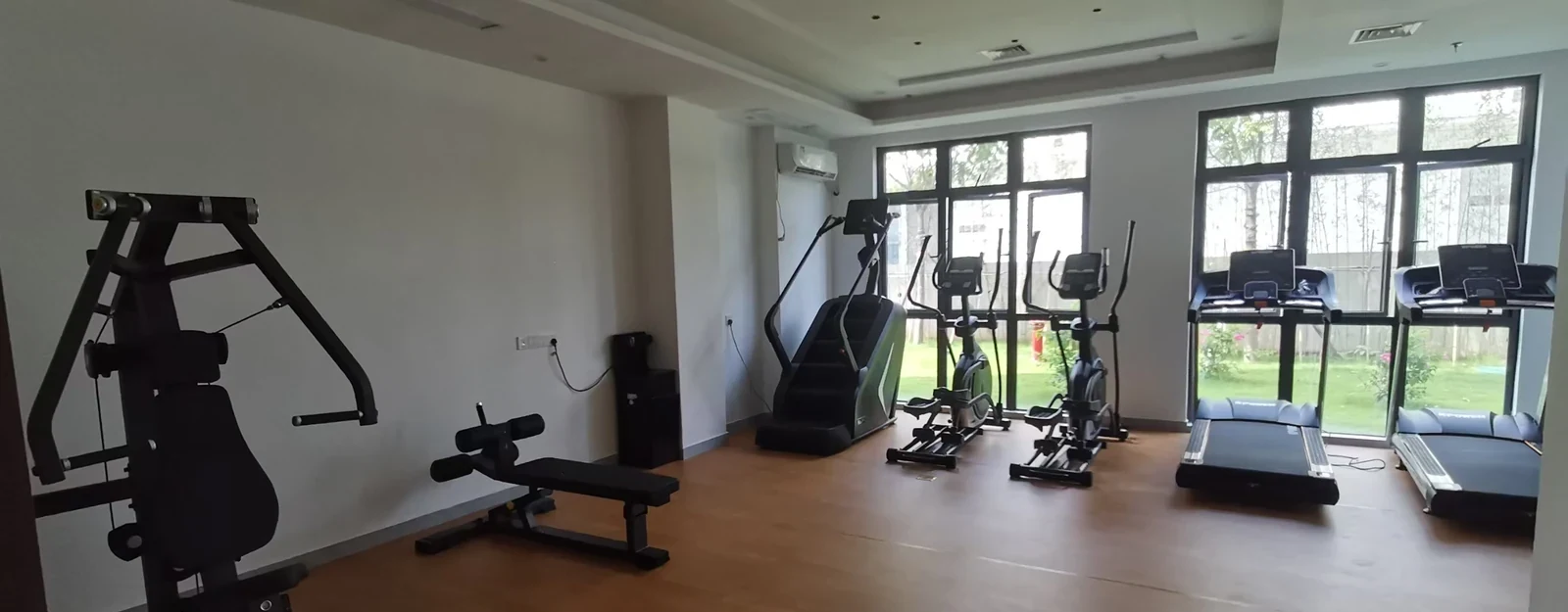
The freight bill barely changes
Here is where most buyers assume they are saving money and are not. An elliptical is narrower, so it must pack better, so it must ship cheaper. Run the packing numbers and the assumption dies.
| Model | Packing size | Packing volume | Net weight | Units per 20GP | Units per 40HQ |
|---|---|---|---|---|---|
| Treadmill DP71 | 2130 × 960 × 400 mm | 0.818 m³ | 210 kg | 34 | 79 |
| Treadmill DP53 | 2080 × 860 × 340 mm | 0.608 m³ | 107 kg | 46 | 106 |
| Elliptical DT51E | 1800 × 550 × 850 mm | 0.842 m³ | 91 kg | 33 | 77 |
| Elliptical DT31E | 1660 × 560 × 790 mm | 0.734 m³ | 64 kg | 38 | 88 |
0.842 against 0.818 cubic metres. The elliptical is 2.9 percent larger to ship, not smaller, and it lands within one unit of the treadmill on a 20-foot container.
The reason is shape. A treadmill collapses into a long flat carton: 2130 mm long, 960 wide, 400 deep. An elliptical stands up: 1800 long, 550 wide, 850 tall. The treadmill is a plank; the elliptical is a wardrobe. A container does not care which way the volume is distributed, and the two numbers come out almost equal.
Which kills a very common piece of reasoning. You do not save freight by choosing elliptical over treadmill. What you save is rent, because the machine you shipped for the same money now needs 37 percent less floor, or roughly half the effective floor once clearance is counted. In a city-centre building where floor is the most expensive line in the project, that is the entire business case. In a suburban warehouse conversion where floor is cheap, it is almost no case at all.
Freight does move between classes, though, and this is worth knowing before you compare quotes across suppliers. A light-commercial treadmill like the DP53 packs at 0.608 m³ against the DP71's 0.818 — that is 46 units per 20-foot container instead of 34, a 35 percent gain in shipping density. The DP53 is a smaller machine on a 25 mm deck with a 150 kg user limit, so it belongs in a hotel annexe or a residential gym, not on a 500 sqm commercial floor. Matching the class to the traffic is where the real freight savings live, not in switching between machine types.
Static load is not the problem. Impact is.
“A treadmill is too heavy for the upper floor” is the single most common thing we hear from hotel and office clients, and it is the wrong worry. Do the division and the weight argument disappears.
| Treadmill DP71 | Elliptical DT51E | |
|---|---|---|
| Net machine weight | 210 kg | 91 kg |
| Plus a 100 kg user | 310 kg | 191 kg |
| Spread over footprint | 2.006 m² | 1.263 m² |
| Static load | 155 kg/m² | 151 kg/m² |
| Difference | — | 2.6 percent |
Two and a half percent. The elevator test, which is what most office slabs were designed for when they were built as offices, is typically 300–500 kg/m². Neither machine is a structural problem, and a treadmill is not meaningfully worse than an elliptical on static load despite being more than twice the weight, because it also spreads that weight over 59 percent more floor.
The real problem is a different physical quantity, and it is why hotel gyms above guest rooms fail acoustic inspections that the structural engineer signed off without hesitation.
A treadmill converts running into repeated impact. Every foot strike sends a transient force spike down through the belt, the deck, the frame and the feet into the slab. The deck and the shock-absorption mounts exist precisely to damp it, and they damp most of it — but not the low-frequency component, which is the part that travels through a concrete slab and arrives in the room below as a structural thud rather than as sound. Structural vibration is hard to absorb after the fact, because you cannot put mass between a slab and the room underneath it.
An elliptical has almost none of that. The feet never leave the pedals, so the force path is closed: the member pushes through the pedal into the crank, the crank turns the flywheel, and the frame only ever sees a smooth tangential load. There is no impact to damp because there is no impact. The machine is 91 kg not because it is cheaply built, but because it does not need the mass a treadmill needs to absorb its own users.
This is the sentence worth taking to your building contractor: on an upper floor you spend money on isolation, not on reinforcement. A floating floor with a resilient layer under it, decoupled from the structural slab, solves what thirteen tonnes of extra concrete would not. And an elliptical-led cardio floor needs far less of that isolation to begin with, because it is not generating the vibration in the first place.
Where the treadmill still wins, and it is not close
None of the above means the treadmill is replaceable. It is not, and pretending otherwise produces gyms with a row of unused ellipticals and an argument at the front desk every evening.
It needs no instruction. This is underrated. A first-time member can get on a treadmill and walk without anyone explaining anything. An elliptical requires a decision — hands on the moving handles or the fixed ones, forward or backward, which resistance — and a proportion of new members will avoid it rather than ask. In a hotel gym where the same guest uses the room twice and never returns, avoidance is total.
Running is load-bearing and walking is not. A treadmill can be used at 5 km/h by a 70-year-old and at 16 km/h by a half-marathon runner, which is a range no other cardio machine on the floor covers. The impact that makes it a structural nuisance on an upper floor is exactly what makes it effective training on a ground floor: bone and connective tissue respond to load, and an elliptical does not apply much.
It absorbs the peak. Every commercial floor at 6 pm has a queue for the treadmills and an empty elliptical. That is not a preference, it is the same behaviour seen everywhere: people default to the machine they already know. Plan the count around the peak, not around the average, or you will have members waiting while equipment sits idle ten metres away.
Practical consequence for sizing: a commercial floor under 200 sqm usually needs at least three treadmills regardless of what the ratio maths says, because two is not enough to absorb a peak and four is usually more than the space can carry. Three treadmills and three ellipticals beats four and one in almost every room we have fitted.
Where the elliptical does a job a treadmill cannot
The elliptical earns its floor in five situations a treadmill cannot cover, and each one has a recognisable signature in the room.
1. Knees and joints. A meaningful share of any commercial membership — and a large share of a hotel or corporate membership — cannot run. Not will not: cannot. Previous injury, osteoarthritis, excess body weight, pregnancy, post-operative rehab. Put a treadmill-only cardio floor in front of that population and you have built a room half of them cannot use. The elliptical is the machine that keeps them training.
2. Vibration and noise. Covered above, and it is the deciding factor on any floor above occupied space. A hotel that puts four treadmills over four guest rooms will hear about it in reviews within a month, and the complaint will be about the building, not the gym.
3. Queue relief without adding a station. A treadmill station turns over slowly because the member has to stop, step off, wipe it down and the belt has to come to rest. An elliptical turns over faster and, more usefully, gives the person who was waiting something to do that is not standing by the treadmill looking at their watch. Two ellipticals next to three treadmills will visibly reduce the queue without changing the count of treadmills.
4. Upper-body involvement. The moving handles pull the arms and back into the movement, which matters for members who find pure running monotonous and quit. Retention is an equipment decision as much as a programming one, and the machine with the second-highest usage in most of our installations is not the second-best treadmill.
5. It is the safer machine. A treadmill is the only cardio machine that can hurt a member through their own mistake — stepping on a moving belt, misjudging a speed change, catching a foot at the rear roller. An elliptical cannot do any of those things; if you stop pedalling, it stops. On an unstaffed floor, at 6 am, with no one to hit an emergency stop, that difference is worth more than the footprint it costs.
There is a specification point under all five. Stride length decides who the machine actually fits. Our commercial units run a 51 cm stride — the DT51E and the DT71E both — against 46 cm on the small-format DT31E. A 46 cm stride under a 185 cm member produces a short, choppy action that reads as "this machine is broken" rather than "this machine is small". If your membership runs tall, the stride number matters more than the flywheel weight on the sheet.
The maintenance bill from year two onwards
The purchase price is a one-time argument. The maintenance bill runs for a decade, and the two machines are not similar in it.
| Wearing part | Treadmill | Elliptical | Why |
|---|---|---|---|
| Run belt | Consumable, 2–4 years | None | Belt runs on a deck under load; it stretches and polishes |
| Running deck | Consumable, 3–6 years | None | Deck wears where the foot strikes, and wear is uneven |
| Lubrication | Every 150 hours or quarterly | None | Belt-deck interface is a sliding friction pair |
| Motor brushes | If DC drive, finite life | None | Self-powered units have no motor at all |
| Roller bearings | Front and rear, replaceable | Crank and flywheel bearings | Similar duty, similar life |
| Drive belt | None (belt is the running surface) | Replaceable, 5+ years | Toothed belt, low load, long life |
| Shock mounts | Replaceable | None | The damping elements themselves age |
Two of the treadmill's seven maintenance lines are friction consumables on a machine that runs eight hours a day. That is the whole difference. An elliptical has bearings and a drive belt, and neither is a wear-per-hour item under normal use.
What this means in practice is not that the treadmill is worse — it is that the treadmill carries a running cost that the elliptical does not, and that cost scales with hours of use rather than with age. A treadmill in a hotel gym used from 6 am to 11 pm will go through belts and decks at roughly three times the rate of the same machine in a corporate room used at lunchtime and after work. Two identical machines, same purchase price, very different ten-year numbers.
The honest planning consequence: budget the treadmill maintenance as an annual line from year two, and budget the elliptical as a call-out item. If a supplier tells you either machine is maintenance-free, ask them what happens to a run belt that has never been lubricated — the answer is that it slips, the machine feels like it is losing power, and the member blames the motor.
Ratios that hold by setting
The ratios below are what we actually specify, by setting. They assume a room with roughly 25–35 percent of its floor given to cardio, which is normal outside of specialist running clubs.
| Setting | Cardio mix | The constraint that decides it |
|---|---|---|
| Hotel, above guest rooms | 60% elliptical / 30% treadmill / 10% bike | Vibration. Treadmills limited and placed over structure, never over rooms |
| Corporate fitness room | 45% elliptical / 35% treadmill / 20% bike and rower | Mixed ages and abilities; lunchtime peak is short and sharp |
| Residential / apartment gym | 50% elliptical / 25% treadmill / 25% bike | Unstaffed floor, so the safer machine gets the larger share |
| Commercial gym, general | 25% elliptical / 55% treadmill / 20% other | Running behaviour dominates and the floor is ground level |
| School / college | 40% elliptical / 25% treadmill / 35% bike and rower | Supervision ratios and a wide range of body sizes |
Two notes on reading that table. First, the percentages are of cardio stations, not of the whole floor — strength always comes first in the budget and cardio fills what is left. Second, the hotel row is the one people argue with, and the argument is usually about a specific room. If the gym is on a ground floor with a car park underneath, the vibration case disappears and the mix should look like the corporate row instead.
For the machine selection inside those ratios, the class ladder in our range is worth knowing because it maps to traffic rather than to price: DT31E at 120 kg user and 46 cm stride for low-traffic rooms, DT51E at 150 kg and 51 cm with 0–15 percent power incline for normal commercial use, and the DT71E at 180 kg with a 14 kg EMS flywheel and 32 resistance levels for high-traffic or premium floors. On the treadmill side the same ladder runs DP53 for light commercial, DP71 and DP72 for commercial, DP72T for the console-heavy end.
If you are working from a room size rather than a member profile, the four fixed-size references are easier to use than a per-square-metre estimate: 100 sqm, 250 sqm, 500 sqm, 1000 sqm. Each lists the actual machines and the zoning that goes with them, so a cardio mix can be checked against a real floor plan rather than argued in the abstract.
What to check before you buy either
Six things decide whether either machine survives year three, and four of them are not on the headline specification.
On an elliptical: stride length first. 46 cm is a home figure, 51 cm is the commercial standard, and anything under 46 cm will feel wrong to most adults. Then flywheel mass, because that is what the smoothness actually comes from: 5 kg on the DT31E, 10 kg on the DT51E, 14 kg on the DT71E. Then the resistance system — a self-generating electromagnetic brake behaves differently from a friction pad, and only one of them stays consistent as the machine warms up. Then the user weight rating: 120, 150 and 180 kg are three different machines, not three prices on the same one.
On a treadmill: motor class before horsepower. A 4.0 HP AC motor (the DP71) delivers its rating continuously. A DC unit sold as “5 HP” typically quotes a peak figure and settles well below it in continuous service, with brushes that have a finite life in running hours. In a home, that never matters. In a room running twelve hours a day it is the difference between a five-year machine and a two-year one. Then deck thickness — 20 mm and 25 mm are the two commercial grades, and 25 mm is what a 185 kg user at 20 km/h needs. Then belt ply and running area: 1400 × 500 mm on the DP51, 1600 × 580 mm on the DP71. Below 1500 mm of belt length, tall members shorten their stride, which is a complaint about the gym rather than about the machine.
For both: what the frame is standing on. Feet that are small and hard transmit vibration; feet that are large and resilient do not. This is invisible in photographs and it is the cheapest place a factory can save money. Put a hand on the frame of a running machine and feel the floor — that is the test, and it takes ten seconds.
And the container question. Both machines pack at roughly 0.8 cubic metres, so neither fills a container by weight. A mixed load of cardio, strength and a rack will reach its weight and volume limits closer together than any single-model order, which is the cheapest way to ship a floor. The arithmetic behind that is in what actually drives commercial gym equipment cost, along with the ratios for checking a quote line by line.
Working out your own mix
Send us the floor area, the setting and the expected peak headcount, and you get a cardio mix with the station count worked out against effective footprint rather than against a catalogue, plus a layout for the room. If the building has occupied space underneath, say so at that point — it changes the mix before it changes anything else.
Send your floor area and peak headcount
Frequently Asked Questions
Space, vibration, maintenance and mix ratios for commercial cardio floors.
Is an elliptical or a treadmill better for weight loss?
Per minute of actual use, running burns more, because it is a load-bearing activity and the body is moving its own weight through space. That comparison is misleading in a commercial room, though, because the machine people use for forty minutes beats the machine they avoid. In our own installations the highest-usage machine is usually a treadmill while the machine members stay on longest is usually an elliptical. If you are fitting out a room for a general population rather than for runners, the elliptical is the safer allocation of the second and third station.
Which one should a hotel gym buy?
Elliptical-led, with treadmills limited and placed away from guest rooms. The reason is vibration, not weight. A treadmill's static load is about 155 kg per square metre against 151 for a commercial elliptical, so neither is a structural problem on a normal office or hotel slab. What travels through the structure is the impact, and low-frequency structural vibration arrives in the room below as a thud that acoustic treatment does not easily fix. A typical mix is 60 percent elliptical, 30 percent treadmill, 10 percent bike, with the treadmills over columns or over non-habitable space.
How much floor space do I need per cardio machine?
Budget on effective space, not footprint. A commercial treadmill such as the DP71 is 2.006 square metres of machine, but it needs about 1.8 m of clear run-out behind the belt, which brings the real requirement to roughly 3.7 square metres per station. A commercial elliptical such as the DT51E is 1.263 square metres with about 0.8 m of clearance behind, so roughly 1.85 square metres per station. That is close to a two-to-one difference, and it is the number that decides how many stations a room actually holds.
Can I put a treadmill on an upper floor?
Yes, and the weight is almost never the reason not to. A 210 kg treadmill plus a 100 kg user over a 2.0 square metre footprint is about 155 kg per square metre, well inside what an office or hotel slab is designed for. The constraint is vibration transmission to the space below. If there is a habitable room underneath, you need a floating floor with a resilient layer decoupled from the slab, and you should place the machines over beams or columns rather than mid-span. An elliptical-led floor reduces how much of that isolation you need in the first place.
Do ellipticals really need less maintenance than treadmills?
Substantially less, and the reason is structural. A treadmill has a sliding friction pair inside it: the belt running on the deck under load. That pair consumes a belt and a deck on a schedule set by hours of use, and it needs lubrication between replacements. An elliptical has bearings and a toothed drive belt, neither of which is a wear-per-hour item. Over ten years the difference is a running cost that scales with traffic, which is why a hotel treadmill used seventeen hours a day goes through consumables at roughly three times the rate of the same model in a corporate room.
What stride length should I choose on an elliptical?
51 cm for commercial use, 46 cm only for low-traffic rooms with shorter members. Stride length is the single specification that decides whether the machine fits the person, and it is the one buyers skip because it is not a headline number. A short stride under a tall member produces a cramped, choppy action that members interpret as a faulty machine. Our commercial units, the DT51E and the DT71E, both run 51 cm; the small-format DT31E runs 46 cm and is meant for apartment and hotel-annexe floors.
How many cardio machines does a 100 sqm room need?
Six to nine stations, and the count is set by the effective footprint rather than by the area. If cardio gets 30 square metres of a 100 sqm room, that is about eight treadmills on footprint alone but only eight stations once clearance is counted, or sixteen ellipticals. A practical split is three treadmills and three to four ellipticals, which fits the effective space, covers both behaviours, and leaves the rest of the floor for the strength core, which is what actually retains members.
Can I ship ellipticals and treadmills in the same container?
Yes, and you usually should. Both pack at roughly 0.8 cubic metres per unit, so a container of either one fills by volume long before it reaches its weight limit. Mixing cardio with strength equipment and a rack brings the volume and weight limits closer together, which lowers the cost per station. A 20-foot container takes about 34 DP71 treadmills or 33 DT51E ellipticals on volume alone, so a real order of two dozen cardio units leaves room for the strength side of the project.


