Fitness equipment manufacturerCommercial home fitness equipment of higher quality
Tel/WhatsApp:+86 180 2651 8045
A dumbbell rack is not a piece of furniture. It decides whether the free weight area stays tidy, whether the dumbbells last, and whether anyone can find the pair they want without lifting four others off the floor.
The failure pattern is predictable. A rack sized for six pairs sits in a room that owns twelve, so six live on the floor. A rack with cradles too shallow lets dumbbells roll forward when a user drops one back in. A rack placed against a wall with 40 cm of clearance in front means the user has to reach over the bottom tier with their legs against the frame.
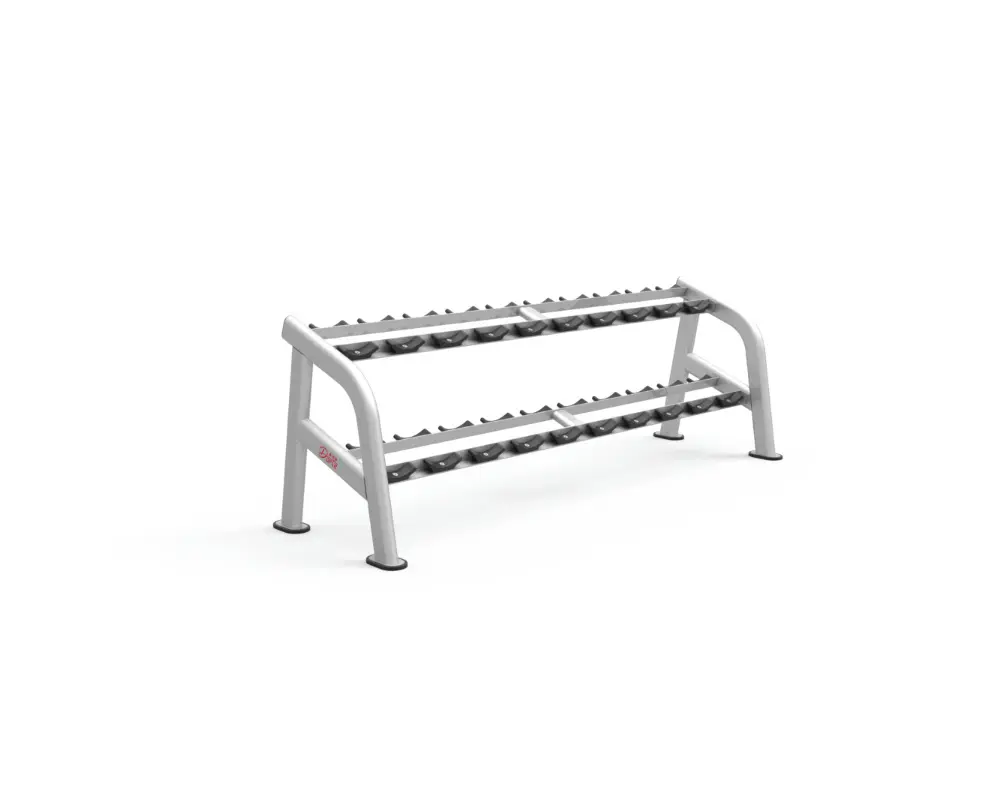
The DL748 holds ten pairs on two tiers, rated to 350 kg total, with fibreglass-reinforced cradle pads and a fully enclosed frame.
Ten pairs is a working set when the dumbbells run 5–50 kg in 5 kg steps. It is not enough when the same room also carries 2.5 kg increments, which is what actually happens: pairs at 2.5, 5, 7.5, 10, 12.5, 15, 17.5, 20, 22.5, 25 already fill the rack before the heavy end is reached.
| Range in use | Pairs | Racks needed |
|---|---|---|
| 2.5–20 kg, 2.5 kg steps | 8 | 1 |
| 2.5–30 kg, 2.5 kg steps | 12 | 2 |
| 5–50 kg, 5 kg steps | 10 | 1, if the light pairs live elsewhere |
| 2.5–50 kg, mixed steps | 20+ | 2–3, or a three-tier rack |
The cradle pad is the part that protects the dumbbell. A bare steel cradle chips the paint off the head and, on a urethane dumbbell, cuts into the surface until the head splits. Fibreglass-reinforced pads hold up far longer than foam or plain rubber, which compress and then tear at the fixing points.
The enclosed frame matters for a different reason: a rack built as two side panels with open shelves flexes at the middle when a 40 kg pair is dropped in. A fully welded frame with a bottom rail does not.
Two smaller checks. Saddle depth should be at least a third of the dumbbell head diameter, or a dropped dumbbell rolls out onto the floor. And the top tier should be at a height a shorter user can reach — around 1.2 m, not 1.6 m.
A three-tier rack saves floor space and costs ergonomics: the bottom tier requires a deep bend, and the top tier is above shoulder height for many users. In a hotel or corporate room where users are not experienced, two tiers at working height is the better choice even if it means a second rack. In a club with limited floor, three tiers is how the range fits at all.
Part of the commercial strength range. Related: benches, plate-loaded stations, racks.

Gym Equipment Factory