Fitness equipment manufacturerCommercial home fitness equipment of higher quality
Tel/WhatsApp:+86 180 2651 8045
Nothing else in a commercial gym costs as little per unit or is asked to do as much. A bench takes a seated user, a lying user and a user with a loaded bar across their chest, several hundred times a week, with no maintenance in between. It is also the item most often bought on price, which is why so many club floors have a bench with a bent frame and a split pad.
Three things separate a commercial bench from a home one: the frame section, the pad, and the locking mechanism. All three fail on cheap units, and all three fail in a way that is dangerous rather than merely annoying.
A flat bench does one thing and does it well: it is stable, cheap and has nothing to break. A decline-flat-incline (FID) bench covers three positions in one footprint, which is why it is the bench most rooms actually buy. The compromise is the mechanism — every adjustable bench carries a pivot and a lock, and that lock is the part that wears.
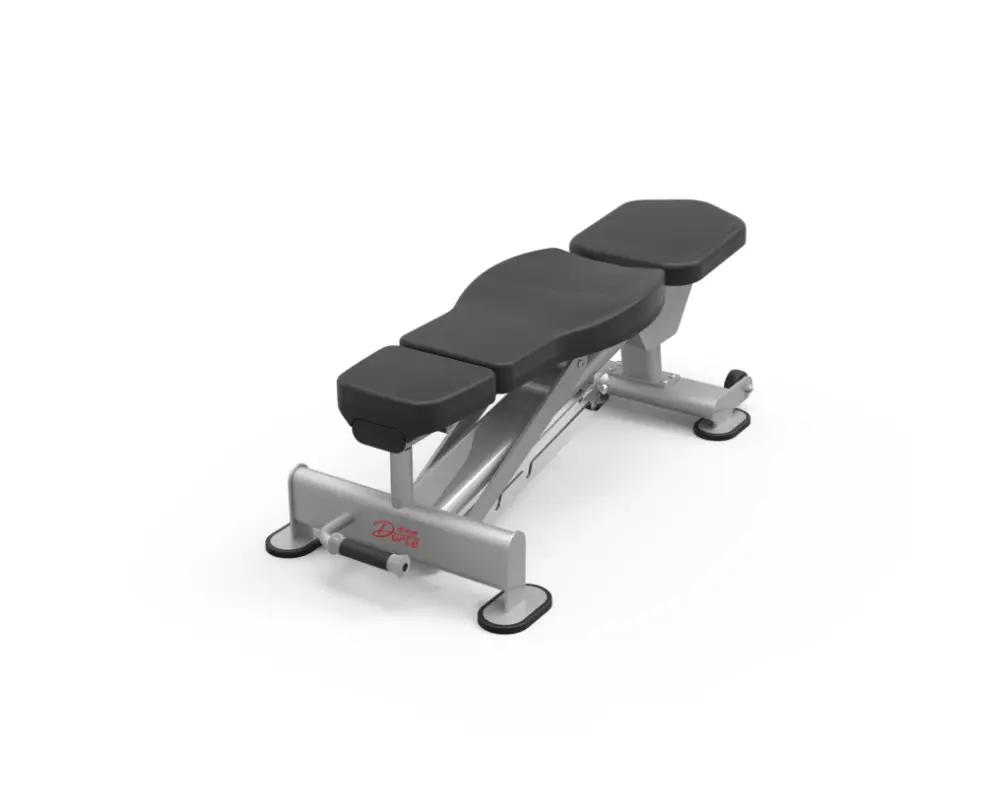
The DL740 is a 160 kg rated FID bench with foot-operated angle adjustment and auto-lock slots. The foot pedal matters more than it sounds: on a bench with a hand-pull pin, the user has to lift the backrest with one hand while pulling the pin with the other, and in practice they set the angle before they get under the bar — or they skip it. Foot operation means the position can be changed while seated.
Auto-lock slots matter for a different reason. A friction lock or a spring pin that has to be fully engaged can be left half-seated. Under a loaded bar that is the failure mode you do not want.
| Dimension | Commercial target | What goes wrong otherwise |
|---|---|---|
| Pad thickness | 60 mm | Thin pads compress to the frame under a loaded set |
| Pad width | 25–30 cm | Narrow pads load the shoulders; wide pads restrict retraction |
| Pad length | at least 120 cm | Short pads leave the head or hips unsupported |
| Frame tube | 50 × 75 mm, 3 mm wall | 2 mm wall flexes at the pivot within a year |
| Rated load | 160 kg minimum | Includes the user, before the bar |
| Height | 43–45 cm at flat | Too high and the feet do not reach the floor for leg drive |
The 43–45 cm figure is the one people ignore. A bench at 48 cm forces shorter users to press with their feet off the floor, which removes the leg drive the lift depends on and puts the whole load through the shoulder.
Transport wheels are worth having on an adjustable bench in a multi-use room. A bench that can be tipped and rolled by one person gets moved out of the way for a class; a bench that has to be carried gets left in the middle of the floor.
Check the upholstery attachment. Stitched and bolted covers can be replaced individually; glued covers mean the whole pad goes back to the factory. In a commercial room the pad is what fails first, so this is a real cost decision, not a detail.
Part of the commercial strength range. Related: racks and Smith machines, plate-loaded stations, dumbbell racks.

Gym Equipment Factory