Fitness equipment manufacturerCommercial home fitness equipment of higher quality
Tel/WhatsApp:+86 180 2651 8045
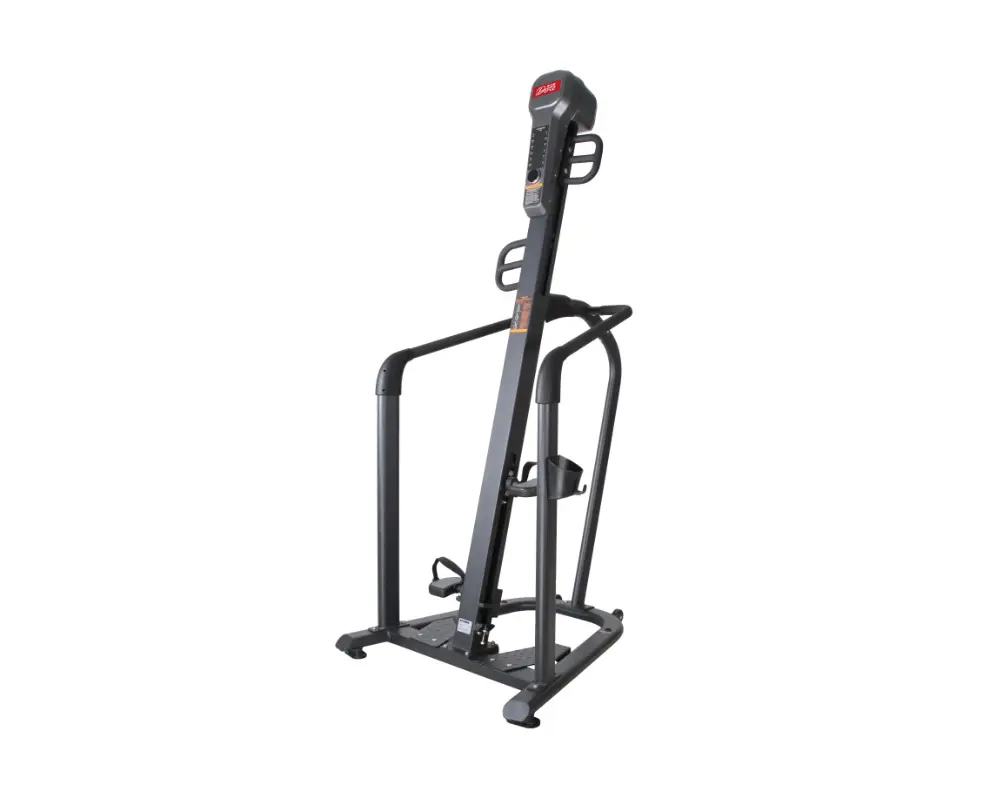
A climb mill is not a stair climber with a different badge. A stair climber gives the user a revolving set of independent steps to walk up. A climb mill drives a continuous climbing surface at a steeper angle — often close to vertical — so the user is pulling as well as pushing, and the hands are part of the movement rather than resting on a rail.
The practical result is that the same 20 minutes costs more. Heart rate climbs faster than on any other machine in the cardio row, and the muscles involved are the ones that running does not reach. That is the selling point, and it is also the reason it is the machine most often bought and least often used.
This machine rewards a member who already trains and punishes a member who does not. In a hotel gym, the usage rate on a climb mill is a fraction of the treadmill beside it. In a club with a serious cardio membership, it is in use every evening.
Two specific points about the DPP71: the frame is Q235 section at 100 × 50 × 2.5 mm, the resistance runs 5–100 levels motorised, and the maximum user load is 150 kg. The 100-level range is worth noting because it is what makes the machine usable by a beginner at all — at level 5 the movement is slow enough to learn on, which is not true of a fixed-resistance climb machine.
| Climb mill | Stair climber | |
|---|---|---|
| Movement | Continuous climbing surface, steeper angle | Revolving independent steps |
| Upper body | Handles are part of the effort | Holds the rails for balance |
| Learning curve | Steep; the first session is hard | Immediate; it is a staircase |
| Typical user | Trained members, conditioning work | General members, all levels |
| Floor space | Small, roughly 1.3 × 0.9 m | Larger, 1.6 × 0.9 m |
| Best setting | Club, sports training, HIIT area | Hotel, corporate, general club floor |
If the room serves a mixed membership and can hold only one, the stair climber is the safer purchase. If the room already has treadmills and bikes covering the general population, the climb mill adds a training option nothing else provides.
The machine itself is compact, but the user is upright and moving. Budget 2.4 m of ceiling for the machine plus a standing user, and 1.2 m of clear floor behind it, because users step on from the rear and step off backwards.
The mistake that comes up repeatedly: placing a climb mill in a row of treadmills facing the same wall, at the same spacing. The user's arms move forward and out, and the machine needs more lateral clearance than a treadmill — 0.9 m between units, not 0.8 m. In a tight row, two users on climb mills collide at the elbows.
Floor: the load is vertical and constant, unlike treadmill impact. A structural slab with 8 mm rubber is sufficient. On a raised access floor, the vibration travels as a low thump that is more noticeable than treadmill noise.
A fixed-resistance climbing machine has two settings: hard and stop. That is why they end up unused. A 5–100 motorised range lets the same machine serve a 30-minute beginner walk and a 10-minute interval session, and it lets an instructor set a program rather than tell the member to hang on and endure.
Worth pairing with a heart rate strap in a club setting. The machine is the one piece of cardio where members genuinely need to pace themselves, and a display showing effort rather than speed is more useful here than a distance readout.
Two wear items: the climbing surface chain or belt, and the bearings behind the pedals or rungs. Both are consumable and both are replaceable on a commercial frame. In a humid room, check the lubrication interval in the manual rather than assuming it matches a treadmill — the loading is different and so is the wear pattern.
Part of the commercial cardio range. Related: stair climbers, treadmills.

Gym Equipment Factory