


How to Choose a Commercial Gym Equipment Manufacturer in China
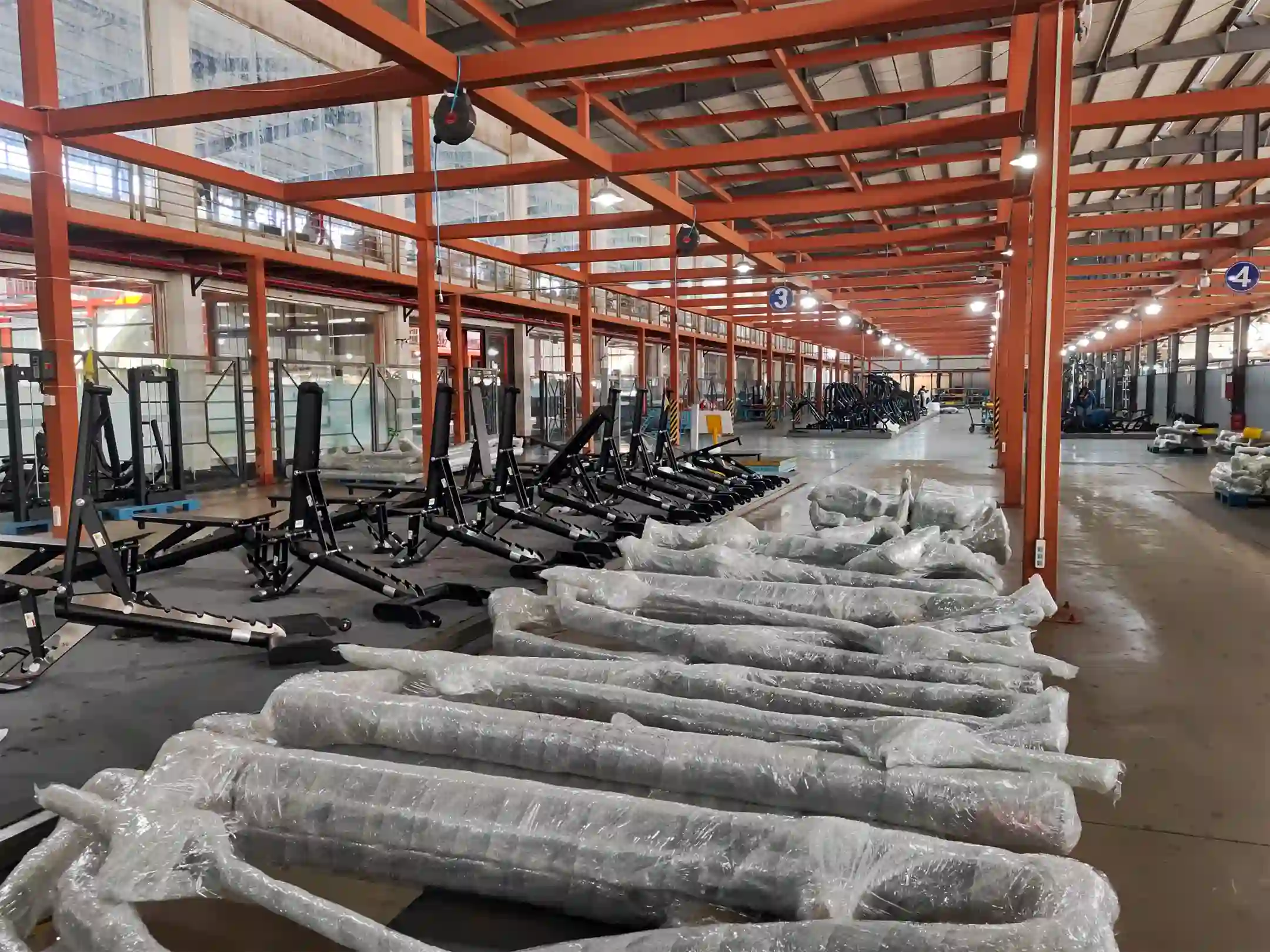
Picking a commercial gym equipment manufacturer in China is mostly a verification job, not a shopping job. Four things decide whether the relationship survives past the first container: whether the company actually runs the production line it shows you, whether the machines match the hours your floor will put on them, whether the paperwork holds up when a customs broker and a service technician start asking questions, and whether your first order is small enough to test the relationship without betting the whole project on it. Price belongs at the end of that list. It is usually where buyers start, which is why so many of them end up with equipment that looks right in a photo and fails in month fourteen.
What follows is the process we walk buyers through, including the parts that make suppliers uncomfortable.
Manufacturer, supplier, trading company: the difference shows up later
The three words get used interchangeably in search results. They are not the same business.
A factory owns welding, painting and assembly. It can change tube thickness, frame geometry, powder color, console software and packaging without asking anyone's permission. When something goes wrong two years later, the people who built the machine are still reachable.
A trading company sources from several factories. A good one gives you a single contact, one consolidated container and someone who knows which province makes which category well. That has real value when you are stocking eight categories and do not want eight sets of Incoterms.
A factory's own trading arm sits in between, and this is where most confusion starts. The catalog looks like a factory because it is one, but the person answering may still be forwarding your technical questions to a different department.
None of these is automatically the wrong partner. Paying factory-direct prices to a company that is not a factory is the mistake, and so is expecting engineering changes from a team that can only forward emails. If you need custom frame geometry or a private-label console, you need the factory. If you need twelve SKUs from four regions in one 40HQ, a competent trading partner will save you months.
Four quick ways to tell which one you are talking to:
- Read the business scope on the business license. Manufacturing and sales are listed separately in China, and the wording is specific.
- Ask for an unedited video walk from the front gate to the loading dock. Editing is where factories get created.
- Ask which components they make in-house and which they buy in. A real factory answers this without flinching: "we weld and paint the frame, the motor comes from a supplier in Jiangsu, the belt from another."
- Check where the sample ships from. If the sample leaves a different city than the factory address, ask why before you send a deposit.
What separates a workable factory from a cheap one
Nine checks cover most of the risk. The right-hand column is what you are listening for, not what you want to hear.
| What to check | What to ask | A workable answer |
|---|---|---|
| Model depth | How many models in the category you care about, and how long has each been in production? | Specific model history, not a 200-page PDF of everything |
| Frame material | Steel grade and tube specification | "Q235, 100×50×2.5mm square tube" beats "high quality steel" |
| Welding | Full seam or spot, and is the weld dressed before painting? | Full seam on load-bearing joints, grinding shown in photos |
| Surface finish | Coating process and film thickness | Two-layer powder coat with clear topcoat, film thickness stated in microns |
| Components | Motor, belt, cable, bearing brands | Named suppliers, and honesty about which parts are bought in |
| Inspection | What is checked, by whom, at which stage | A written routine with a pre-shipment step, not "we check everything" |
| Packing | Carton, foam, corner protection, plywood frame | Explains why a treadmill ships partly disassembled and how it reassembles |
| Spare parts | Wear parts list and availability window | A list with part numbers, not a promise that nothing wears out |
| Response quality | Do technical questions come back answered, or forwarded? | Answers with a drawing or a photo attached |
Two of these deserve more than a table row.
Tube specification is where I would start. On cardio equipment, wall thickness and frame geometry do most of the durability work. A 2.5mm wall on a 100×50mm tube behaves very differently from a 1.8mm wall on the same profile, and the difference does not show up in a product photo. Ask for the specification in writing and check that it appears on the spec sheet you receive with the quote.
Packing deserves its own conversation. Buyers spend weeks on machine specs and five minutes on packing, then lose a container to rust and bent handrails. Ask how the deck is braced, whether electronics are boxed separately, whether the plywood frame is fumigated, and whether the packing list matches what actually goes inside. On mixed containers, ask for photos of the loading sequence.
How to audit a factory without flying to China
A factory visit is the best audit. Most buyers cannot make one before the first order, and a plane ticket does not fit a first-order budget anyway. Video and documents cover more ground than most people expect.
Start with the video. Ask for a single continuous walk, no cuts, no music. It should pass the welding stations, the powder coating line, the assembly area, the finished-goods warehouse and the loading bay. Ask them to open a container that is already loaded. Ask them to show the QC bench and the calibration sticker on the test equipment. A factory that hesitates on any of these is telling you something.
Then the sample. Pay for it. A free sample is a marketing expense and gets treated like one. A paid sample tells you how the factory handles an order, how it packs, what documentation comes with it, and whether the sample fee is credited against the first order. Compare the sample against the spec sheet line by line, and ask directly whether the production run uses the same bill of materials.
Third-party inspection is worth the money on a first container. SGS, Bureau Veritas, TÜV and Intertek all run pre-shipment inspections in Guangdong. The report covers quantity, workmanship, packing and function checks against your approved sample. Agree in advance who pays, and write the acceptance criteria into the purchase order, because "cosmetic defects acceptable" means something different to every inspector.
Loading records close the loop. Container number, seal number, photos of the loading, and a packing list that matches the count on the dock. Keep them. If a claim comes up in six months, these are the files that decide it.
How to write an RFQ that gets a useful answer
Most inquiries that get ignored read like this: "Please send your best price and catalog."
Nothing in that sentence tells a sales engineer what to quote. A quote request that gets a real answer usually contains:
- Model numbers or the category plus quantity
- Destination port, not just the country
- Voltage and plug standard, since 110V and 220V builds are not the same machine
- Logo and color requirements, with artwork if you have it
- Packing preference, especially if you need mixed SKUs in one container
- The delivery window you are working toward
- Payment terms you can actually execute
- Whether you want spare parts and wear items in the same shipment
The destination port item surprises people. A quote to a port with no direct service from Shenzhen or Guangzhou carries inland freight and a longer transit, and that difference shows up in the total landed cost, not in the unit price. If you are comparing offers, compare CIF to your port, not FOB from a factory you have never shipped from.
Voltage is the other quiet one. A 220V machine sent to a market running 110V at 60Hz will either not start or will run hot until it does not. State it in the first email and you save a month.
Four ways buyers work with a Chinese factory
Single-model full container
One or two models, loaded to capacity. Best for distributors restocking a proven seller. Lowest unit cost, least flexibility.
Mixed container
Several categories in one container. Standard for retailers and small chains, and the point where packing discipline matters most, because a treadmill carton and a selectorized machine crate do not stack the same way.
Project package
A hotel, apartment block or new gym buys a complete floor: cardio, strength, free weights, flooring, sometimes installation. This route needs a floor plan and a usage estimate, and the quote should arrive as a layout, not a price list. Our gym solutions page shows what that package looks like across equipment categories.
OEM and ODM
Private label, custom color, custom console graphics, modified upholstery, your own carton printing. The engineering scope decides the timeline, not the logo file. If you are planning this route, read the ODM process before you request pricing, because most of the delay sits in specification approval rather than production.
What we can tell you up front, and what we cannot
We are Huizhou Ledong Health Equipment Co., Ltd., a fitness equipment manufacturer at No. 29 Maidi Road, Huicheng District, Huizhou, Guangdong. We have been building gym equipment for more than 20 years, in a 25,000 square meter factory, and we run R&D, manufacturing and sales under one roof.
| Company | Huizhou Ledong Health Equipment Co., Ltd. |
| Location | No. 29 Maidi Road, Huicheng District, Huizhou, Guangdong, China |
| Experience | More than 20 years in fitness equipment |
| Factory area | 25,000 square meters |
| In-house functions | R&D, manufacturing, sales |
| Cardio line | Treadmills, indoor cycles, ellipticals, rowers, stair climbers, air bikes |
| Strength line | Selectorized, plate-loaded, cable and functional trainers, multi-stations, benches, storage |
The full range, with specifications, sits on the fitness equipment page.
What we will not do is put a number on this page that only holds for one model in one finish. MOQ, certification documents, warranty terms and current lead times depend on the machine, the color, the console and the season. We quote them per project, in writing, and we would rather send you a document you can check than a headline that falls apart in the second email.
If you want a reference point for build quality before you contact anyone, look at a specific model rather than a category. The commercial treadmill DP53 page lists motor, belt, incline and frame figures you can compare against other suppliers, and the strength equipment section shows how the frames and upholstery are put together.
FAQ
How do I verify that a Chinese gym equipment manufacturer is a real factory?
Check the business license for a manufacturing scope, request an unedited video walk of the production line and loading area, and confirm which components are made in-house. A real factory will name the parts it buys in. Cross-check the address on the license against the address on the invoice and the shipment documents.
What is a typical MOQ for commercial gym equipment from China?
There is no standard figure. MOQ usually depends on the model, the color, whether a logo is printed, and whether the order fills a container. Factories that quote one flat MOQ across a whole catalog are usually quoting a policy, not a production constraint. Ask what the MOQ is for the specific model and finish you want.
Should I buy from a trading company or a direct factory?
Buy direct when you need custom specifications, engineering changes, private label or long-term spare parts support. A trading company can be the better choice for a mixed container assembled from several factories, as long as you know that is what you are paying for and the price reflects it.
How long does production take?
It depends on the model, the finish, the quantity and the season. Chinese production slows around Chinese New Year and tightens before peak shipping periods. Ask for the production schedule in writing with the order, and build your retail or opening date from that date rather than from the quote's headline lead time.
What should be written into the sales contract?
Model and specification, quantity, color and logo approval, packing method, spare parts list, inspection standard, payment terms, shipment date, and what happens if the goods fail inspection. Photographs of the approved sample should be attached as an annex. A contract that describes the machine only by model number leaves too much room.
Can I mix different equipment categories in one container?
Yes, and most first orders do. The constraint is volume and stacking, not category. Send the model list with quantities and ask for a loading plan before you confirm, because the plan often shows that one more pallet fits, or that a machine you assumed would fit does not.
Request a factory-direct quote
Send us four things and you will get a quote you can actually compare: the equipment list with quantities, your destination port, the voltage standard at the site, and whether you need logo or color changes. If the project is a full gym, attach the floor plan and we will come back with a layout and a line-by-line quote instead of a catalog.


