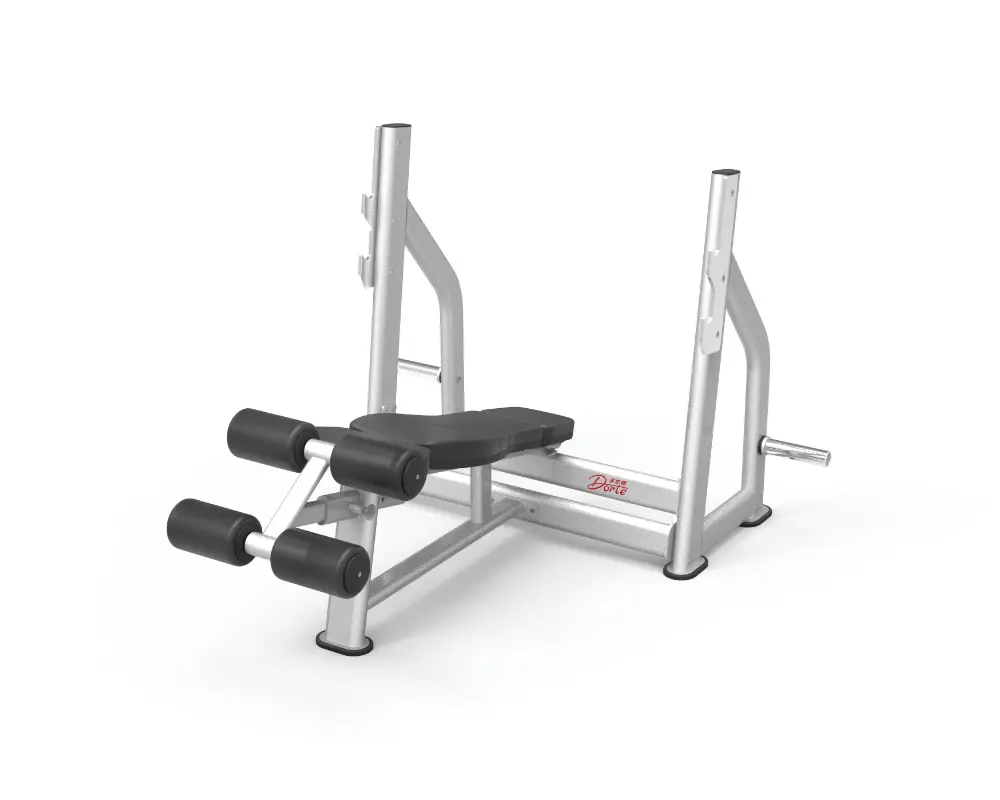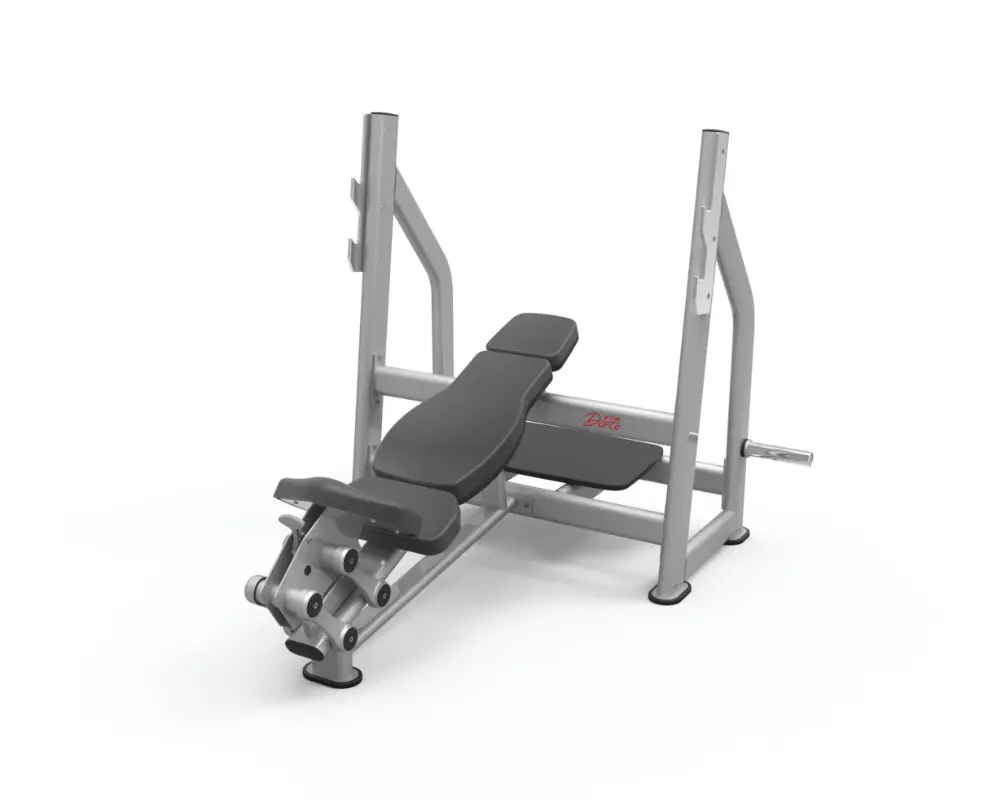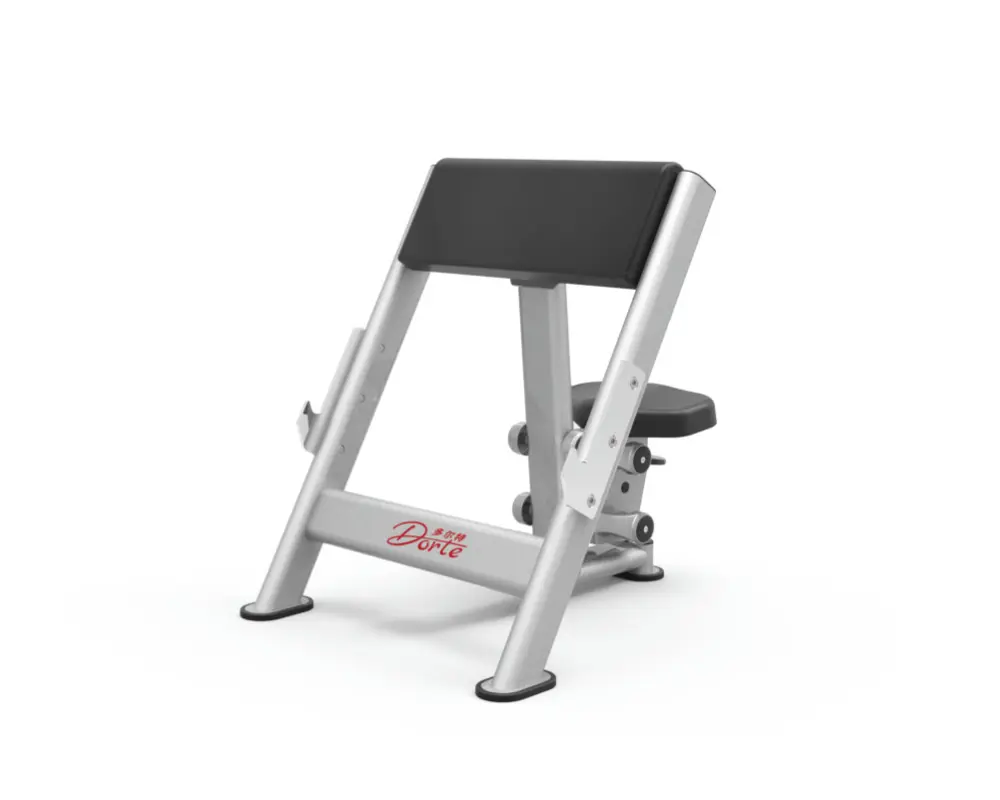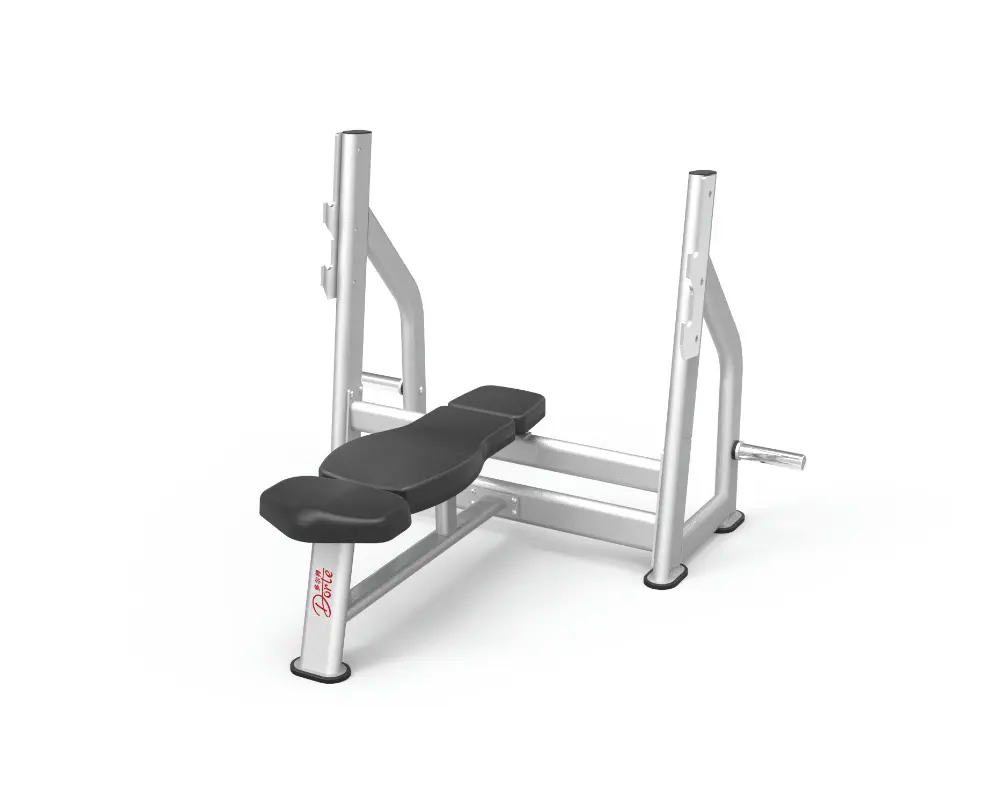

Product Model
| Specification | DL738 |
|---|---|
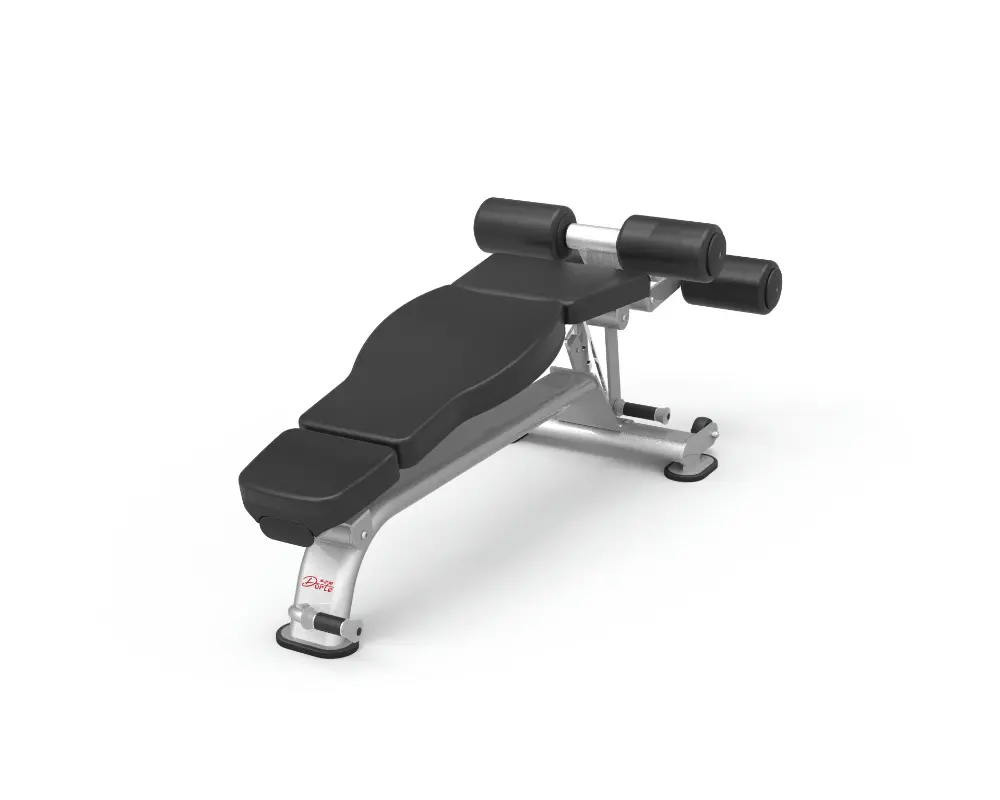
| Target muscles | Abdominal muscle group as the primary target, with the hip flexors taking load on the way down and the obliques doing their share whenever the angle is raised |
| Product size | 1680*666*608mm |
| Counterweight | None - bodyweight only, no weight stack and no plate loading |
| Net weight | 55KG |
| Maximum load capacity | 160KG (user rating - there is no weight stack to rate) |
| Main frame specification | Q235 steel, 120*50*3.0mm flat elliptic tube |
| Seat pad | One-piece foam with PU leather cover |
| Ankle pad | Adjustable on the DL738 - the fixed-angle DL739 shares this frame without the adjustment |
| Angle adjustment | Foot-operated release with auto-lock detents - detent count and angle range are not stated on the current datasheet |
| Mobility | Fitted with castors - castor count and lift end not stated on the current datasheet |
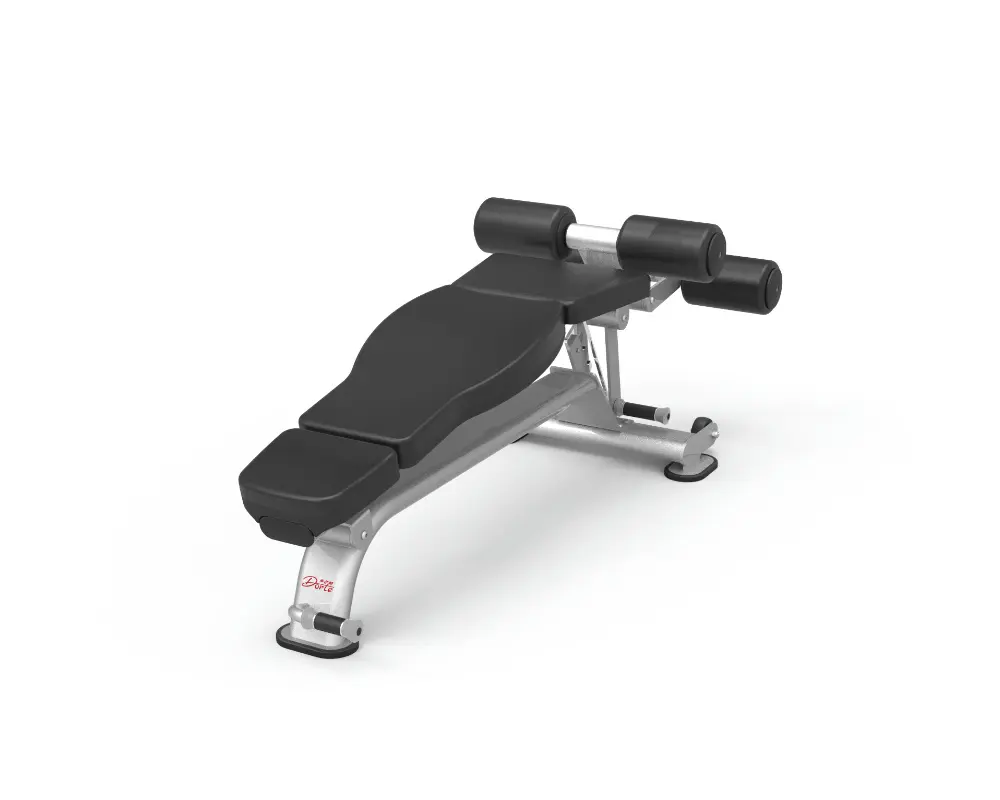
Every DL738 has its adjustment mechanism cycled through the full detent range by hand before the pads go on, with the load path through each stop checked and the ankle pad run to both ends of its travel. A detent that skips under load is the one fault a member cannot see coming, because the pad moves while the torso is already committed.

Ask for the DL738 detent count and angle range before the order
Two Benches, One Drawing, Half a Line Apart
The catalogue lists the DL738 and the DL739 as two products, and on every measured line they are the same machine. Both are 1680 x 666 x 608 mm, both weigh 55 kg, both carry a 160 kg user rating and both are built on the Q235 flat elliptic tube at 120 x 50 x 3.0 mm.
The divergence appears on line seven, the feature line. The DL738 adds an adjustable ankle pad, an assist handle, a foot-operated angle change with auto-lock detents, and castors. The DL739 lists the frame angle and stops there.
That is the entire difference between the two part numbers, and it is worth being precise about what it is not. It is not a heavier frame, not a wider pad, not a different tube. Same steel, same footprint, same rating — and one of them can change its angle while the member is lying on it. Whether that is worth paying for depends on a property of abdominal benches that does not apply to any other piece of plate loaded equipment on the floor, which is the subject of the next section.
On an Ab Bench the Angle Is the Only Weight Stack
A bench press has a barbell. A lat pulldown has a stack. A leg press has plates. An abdominal bench has none of those things and never will — the load is the member's own torso, and the only way to make it harder is to tilt the surface it is pivoting from.
The arithmetic is straightforward. What the abdominal muscles resist on a decline sit-up is the component of body weight that resolves along the bed, and that component scales with the sine of the angle. At 15 degrees it is about 26 per cent of body weight. At 30 it is 50. At 45 it is 71. For a 75 kg member that is 19.4 kg of resistance at the shallow setting and 53.0 kg at the steep one — a spread of 2.7 times, the difference between a bar loaded to 19 kg and one loaded to 53 kg.
No other machine on a commercial floor covers a 2.7-fold range with a single lever that the member controls. A selectorized machine covers it with a pin in a stack. A rack covers it with plates on a sleeve. On an abdominal bench it is a hole, a pin or a detent, and if the bench does not have one, the range does not exist.
That reframes the purchase decision. The question is not whether an adjustable abdominal bench is better than a fixed one. It is whether a single setting can serve the strength spread of the membership standing in front of it. In a corporate fitness room where the median member does three sets of crunches twice a week, it usually can. In a gym with a competitive bodybuilding clientele, a 15 degree pad and a 45 degree pad are two different exercises and neither one substitutes for the other.
Feet-Adjust and Auto-Lock Are What the Extra Money Buys
If the whole value of the difference sits in one adjustment mechanism, then the mechanism only pays if it is used, and this is where the majority of adjustable benches fail. An adjustment that requires dismounting is an adjustment that does not happen.
Picture the ordinary sequence on a pin-adjusted bench. The member lies down, does a set at whatever setting the bench happens to be on, decides it is too shallow, sits up, swings a leg over, walks to the pivot, pulls a pin, finds the next hole by feel, pushes the pad up, returns, lies back down and repositions under the ankle pads. That is between forty seconds and a minute of getting up and down, and the great majority of members will do it once and then leave the bench where it is for the rest of the year.
The DL738 changes that sequence in two places. The foot-operated release lets the member set the angle from the lying position, and the auto-lock detent means it lands on the next stop without hunting for a hole. The assist handle takes the load of the moving pad off the wrist while it is being repositioned. The member still has to think about the setting, but the physical cost of changing it drops to almost nothing, and behaviour follows physical cost.
That is the honest case for the DL738 and it is narrower than the catalogue suggests. You are not buying a better bench. You are buying a bench whose adjustment feature will actually get used. On a fixed-angle bench nobody is disappointed, because nobody expected to change anything. On an adjustable bench with an awkward release, the feature is on the invoice and never on the floor.
One caveat that belongs in writing. The datasheet does not state how many detents the mechanism carries or what the angle range is, and those two numbers decide whether the adjustment is genuinely useful or merely present. A five-stop range from 10 to 35 degrees is a different product from a three-stop range from 20 to 30. Ask for both numbers before the order, and ask what stops the pad from dropping through a detent under load.
1680 mm of Floor for a Bench You Lie On
The footprint is 1680 x 666 mm, or 1.119 m², with a 608 mm pad height. Set against the rest of the series that puts it between the benches and the racks: the DL741 flat utility bench is 1234 x 528 mm, the DL740 adjustable utility bench is 1365 x 606 mm, and a barbell press bench runs to about 2.9 m².
The proportions are the interesting part. At 666 mm wide it is 950 mm narrower than the 1616 mm press benches in the same series and barely wider than a member's shoulders, so it slips into gaps a bench press cannot use — between a column and a wall, at the end of a dumbbell rack, in the dead strip beside a doorway. That is deliberate. This is a piece that lives against a wall and gets pulled out.
The 1680 mm depth is the fixed part. There is no folding hinge and no telescoping section, so the bench claims its full depth whether the abdominal block is running or the room is being reset for a class. Against a wall it can stand sideways and take 666 mm of the run; pushed in perpendicular it takes the whole 1680. Which way it faces is a layout decision, not a detail.
The 608 mm height is worth a note too. That is 167 mm higher than the DL740 utility bench at 441 mm, and the difference is the decline itself: the hips sit up and the torso runs down toward the head end. A member mounts this bench by sitting on the high end and lying back, not by straddling it, which means the high end wants clear floor in front of it rather than being pushed flat to a wall.
Both versions carry castors, which tells you how the design expects the bench to be used. A 55 kg frame on wheels is a frame meant to be moved — out for the abdominal block, back against the wall afterwards. Check how many castors there are and which end lifts, because a two-wheel arrangement that lifts at the head end handles very differently from one that lifts at the foot end in a tight corner.
The Fixed-Angle Version Is a Different Product, Not a Cheaper One
It would be easy to read the DL739 as the DL738 with the good parts removed. On the specification sheet that is exactly what it looks like. On the floor it is a different product answering a different question.
A fixed-angle abdominal bench is a standardisation tool. Every member works at the same angle, every session, on every bench in the room, which is what a group abdominal class needs, what a uniform physical training programme needs, and what a coach running twenty people through the same circuit needs. Consistency is not a compromise there; it is the requirement.
It also removes a failure mode. An adjustable bench has a mechanism, and a mechanism has detents that wear, pins that get lost, and pads that drop a notch under load. A fixed bench has none of that, and in a room with no maintenance schedule and high traffic, that is a real argument that has nothing to do with price.
So the choice between the two tracks the room rather than the budget. Adjustable where members train individually and the strength spread is wide; fixed where the room runs a programme and consistency matters more than range. Buying the fixed one to save money and then discovering the membership needs three angles is the expensive version of this decision, and so is buying the adjustable one for a room where nobody will ever touch the release.
There is a third path worth mentioning for a mixed room. One adjustable bench and one fixed bench covers both cases for less than two adjustables, and it also gives the floor a control: the fixed bench establishes the standard angle, and the adjustable one is where a member goes when the standard does not fit.
What to Ask Before the Order Goes In
How many detents, and over what angle range. Neither number is on the current datasheet, and both decide whether the adjustment is worth having. A three-stop mechanism spanning 20 to 30 degrees is barely an adjustable bench.
The ankle pad adjustment span. The lower leg runs from roughly 350 mm to 480 mm across the adult range, and the pad height has to catch the member above the instep rather than across the toes. Ask for the span in millimetres, not for the word adjustable.
What holds the pad during a set. Auto-lock detents are a convenience until one lets go mid-rep with a member's full torso load on it. Ask how the stop is loaded and whether it is rated for the 160 kg figure or for something smaller.
The clear depth behind the head. Of the 1680 mm, how much is frame and how much is head clearance, and can the frame run closer to a wall if the member mounts from the side. This decides whether the bench fits the corner you have in mind.
Castor count and lift end. Two castors and a lift at one end, or four and a full lift. It sounds trivial until a 55 kg bench has to be moved twice a session in a 6 m wide room.
One supply note. The DL738 and the DL739 are the same frame on the same line with the same tube and the same pad, so a mixed order of both runs as one batch and one set-up. Ordering one of each six months apart means paying that set-up twice, which is usually more than the difference between the two part numbers.
The short version: if the room trains individuals and the membership spans beginners to competitors, the adjustable bench is the one that gets used. If the room runs a programme, the fixed bench is not a downgrade — it is the correct specification.
Frequently Asked Questions
Detent range, ankle pad span, footprint and layout questions about the DL738.
What is the difference between the DL738 and the DL739?
Only the adjustment mechanism. Both are 1680 x 666 x 608 mm, 55 kg, 160 kg rated, on the same Q235 120 x 50 x 3.0 mm tube. The DL738 adds an adjustable ankle pad, an assist handle, foot-operated angle adjustment with auto-lock detents and castors; the DL739 lists a designed frame angle with none of those.
How many angle positions does the DL738 have?
The current datasheet does not state a number or a range. This is the first thing to confirm in writing, because the count decides whether the bench covers the strength spread of a real membership or only gestures at it. Ask for the detent count and the minimum and maximum angle in degrees.
Does it need a weight stack or plates?
No. The DL738 is a bodyweight bench and the counterweight line reads none. What the abdominal muscles resist is the component of body weight acting along the bed, which is why the angle is the only way to change the difficulty — there is nothing else to load.
What does the 160 kg rating mean on a bench with no weight stack?
It is a user rating for the frame and the pads, not a resistance figure. The working load is the member's own torso. If the room runs heavy weighted sit-ups with a plate held at the chest, ask separately whether the pad and the detent are rated for that added load.
Can the ankle pads be adjusted for different leg lengths?
Yes on the DL738, and this is one of the four features that separates it from the DL739. The datasheet does not give the span, so ask for it in millimetres and check the setting that fits the shortest member in the room, because that is the position that gets tested first.
How much floor space does it need?
1680 x 666 mm on the frame, 1.119 m², plus clear depth behind the head so the neck is not hanging off the end. It is narrow enough at 666 mm to fit gaps a bench press cannot use, and the castors mean it can live against a wall between sessions.
Why is the pad height 608 mm when a utility bench is 441 mm?
Because the bench declines. The hips sit high and the torso runs down toward the head end, so the mounting edge is at 608 mm. A member sits on the high end and lies back rather than straddling the bench, which means that end needs clear floor in front of it.
Is the foot-operated adjustment reliable in a busy gym?
It is a mechanical detent with no cables and no electronics, which is the right architecture for a commercial floor. What matters is the load path through the stop and whether the pad can be made to drop a detent by pushing down on it — test that before the bench goes out.
What angle should a beginner start at?
Shallow. At 15 degrees the resistance is roughly a quarter of body weight, which is where a member who has never trained abdominals should begin. Steepening the bench is the progression, and being able to do it without getting up is exactly what the foot release is for.
Can it be used at home?
It can, and the 55 kg frame with castors suits a room where equipment gets moved. The caution is the footprint: 1680 mm of depth is a lot for a spare room, and the bench has to sit somewhere the head end can stay clear rather than pushed flat into a corner.