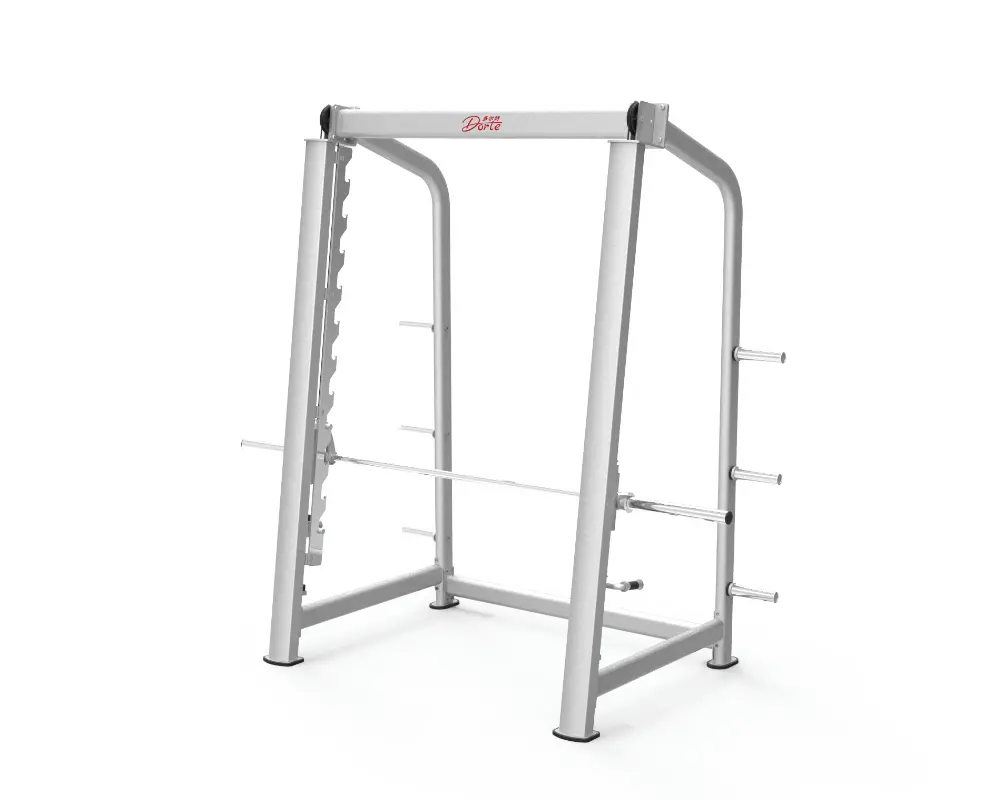

Product Model
| Specification | DL733 |
|---|---|
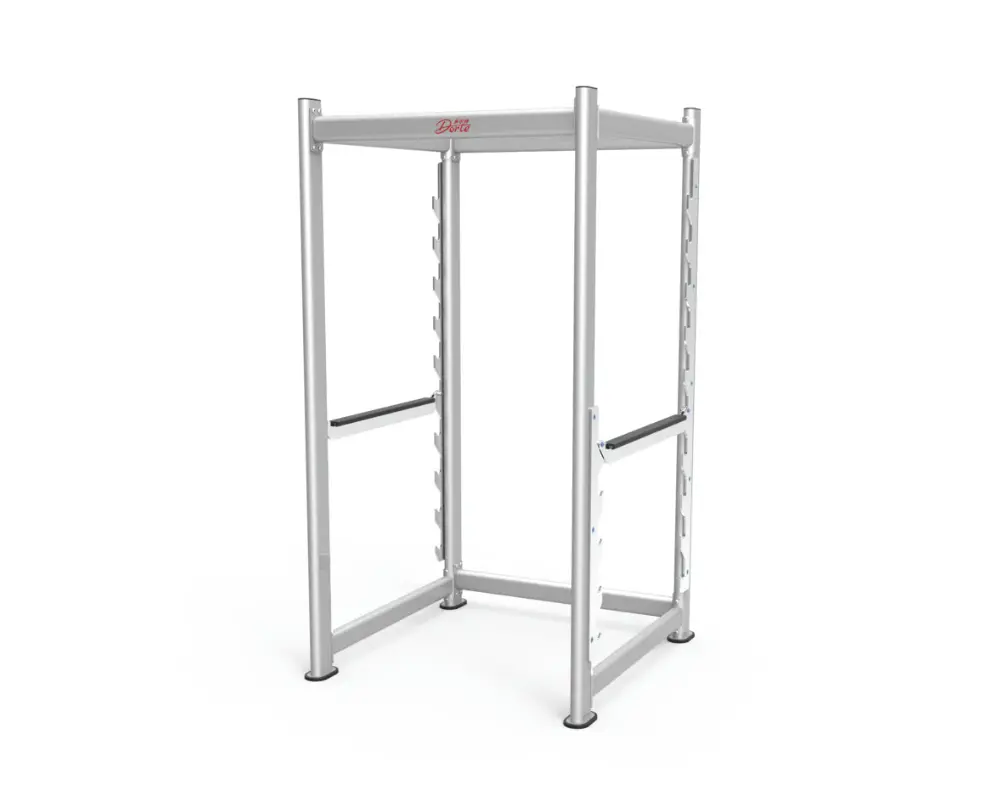
| Target muscles | Upper body, back, chest, shoulders and legs - every barbell movement the frame is used for, from back squat and bench press to overhead press and rack pull |
| Product size | 1279*1310*2323mm |
| Counterweight | None - the rack takes a barbell and plates, supplied separately |
| Net weight | 173KG |
| Maximum load capacity | 160KG (user rating - barbell capacity quoted separately) |
| Main frame specification | Q235 steel, 120*75*3.0mm bread-type tube for the main frame; 120*50*3.0mm flat elliptic tube for secondary members |
| Safety | Adjustable safety spotter arms on both uprights; limit mechanism listed in the specification |
| Barbell capacity | Not stated on this specification - confirm with the factory before ordering |
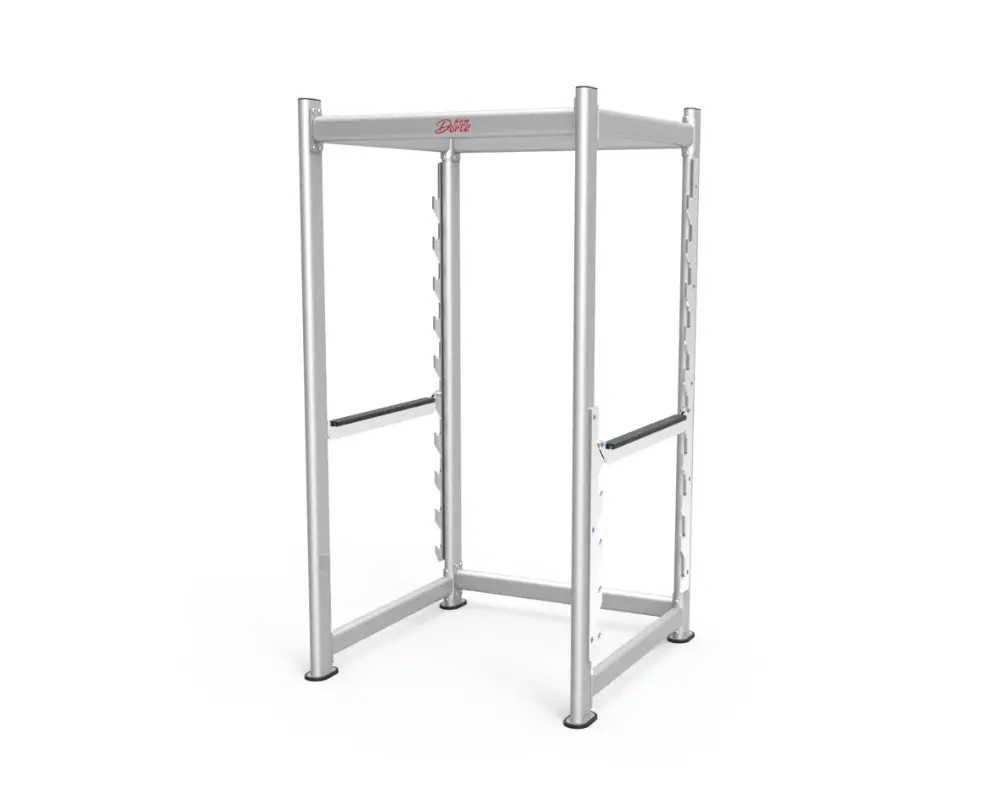
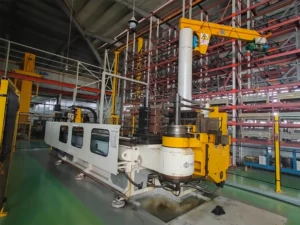
DL733 is squared on the assembly floor with both diagonals measured and recorded before the uprights are torqued, because a frame that ships out of square cannot be corrected by the bolts that hold it.
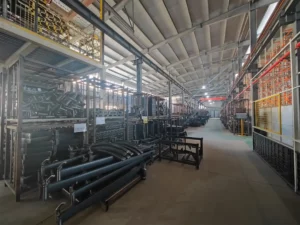
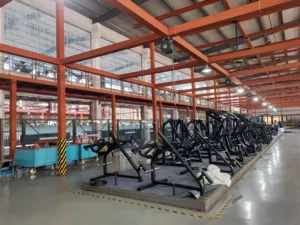
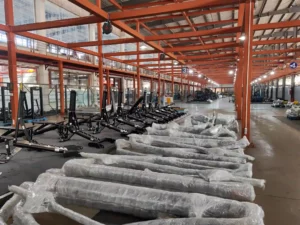
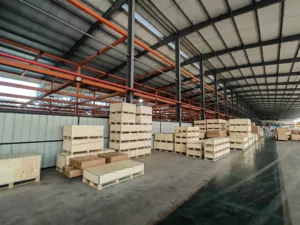
Ask for the DL733 barbell capacity and the safety arm hole spacing
320 kg on the Smith Machine, 160 kg on This One
Two barbell stations sit in the same range and their load figures differ by a factor of two. The DL732 Smith machine is listed at 320 kg. The DL733 power rack is listed at 160 kg. Read on its own, that gap looks like a warning about the rack.
It is not. The two numbers are measuring different things, and the difference is structural rather than a judgement about steel. On a Smith machine the member stands outside the frame and the bar is captive on rails, so the load figure can only be the barbell. On a free-weight rack the member stands inside the frame, under the bar, between the uprights — so the figure on the sheet is the person. 320 kg of barbell and 160 kg of human are not competing claims. They are answers to two questions that happen to share a column.
The 160 kg reading is consistent right across the strength line, which is how you can tell what it means. The seated leg stations, the bench stations and this rack all quote 160 kg, and none of them is a machine you would describe as light-duty. One figure repeated across a whole family is a rating for the person on it, not a limit discovered separately for each frame.
Which leaves the number a rack buyer actually needs, and this specification does not state it: how much barbell the frame carries. That is a separate rating, it is set by the uprights, the J-hooks and the crossmembers, and on this sheet it is missing. It is also the first thing to ask for, because it is the only figure that says whether the rack suits the room.
The reason it matters is that barbell load is not static. At the bottom of a squat the bar decelerates and reverses, and measured ground reaction forces in back squats commonly reach 1.3 to 1.5 times the system weight — higher in a missed repetition caught on the safety arms. A 90 kg member squatting 140 kg is 230 kg standing still and somewhere between 300 and 345 kg at the turnaround, forty times a session.
That is what the 173 kg of Q235 is doing. The steel is not there to make a number on a page look respectable; it is there to keep the uprights and crossmembers from moving when a load that size reverses direction. A frame that passes a static test can still walk across the floor over a season, and mass at the base is an inexpensive defence against it.
Three questions settle the capacity faster than any rating does, and none of them is printed on the sheet. What is each J-hook rated for, how many crossmembers tie the two side frames together, and does the base connect by bolts or by welded gussets. The first gives you the point load, the second tells you whether the rack is a box or two ladders standing near each other, and the third tells you whether it can be taken apart and put back square on site. Ask all three before the 160 kg figure is allowed to decide anything.
The Tube Profile Is Chosen for Twist
A rack does not fail by being crushed. It fails by twisting, and the common causes are not misuse. A bar racked with one sleeve caught on the hook and the other still outside it puts the frame in torsion. So does stripping the plates off one side first. So does a member swinging on a chin bar if the frame carries one. The load that opens a weld on a rack is almost never vertical.
Section shape is chosen for that. A round tube resists torsion well and bending poorly; a square tube does the reverse at the same wall thickness. The 120 x 75 x 3.0 mm bread-type tube on the main frame is neither of those things. It is a flattened profile with the material pushed away from the centre, which raises the torsional section modulus well above a square tube of the same mass, and the 1.6-to-1 height-to-width ratio makes the frame stiffest front-to-back — the direction the bar actually moves.
The 120 x 50 x 3.0 mm flat elliptic tube on the secondary members is the same logic on a different job. Crossmembers and braces do not carry the main bending moment, so they do not need the depth. What they need is a flat face for a full-length weld and enough section to stop the frame lozenging under a side load. A flat profile gives both at roughly half the mass of a square tube of the same width, which is why the whole rack lands at 173 kg rather than at two hundred and something.
That brings up the question the profile cannot answer: how the joints are welded. A continuous weld all round a joint is the stronger choice against torsion and pulls the frame out of square as it cools, because the shrinkage is uneven and there is a great deal of it. An intermittent weld keeps the frame straight and leaves an unwelded gap where moisture sits and rust starts. Neither choice is wrong; they are different trades. What is wrong is a rack where the decision was never made and the weld runs wherever the jig allowed that morning.
You can see which one you are being sold, and it takes one look at the inside corners of the joints rather than the outside. The outside is ground and powder-coated on every rack at every price. The inside corner either has a continuous bead running past it or it does not, and that single look tells you more about how the frame was built than the tube specification does.
Square It Before You Load It
At 173 kg and 2323 mm tall the DL733 ships knocked down, because no container takes a rack of that height assembled and no service door takes one at that width. It arrives as two side frames, crossmembers, J-hooks, safety arms and a base kit. Everything about the steel is settled before it leaves the factory. Everything about how the rack behaves is settled in the hour it is assembled on site.
The measurement that decides it is the diagonal. On a rectangular frame that is square, the two diagonals are equal. On one that is out by 3 mm at a corner they differ by about 6 mm, and the two side frames lean toward each other or away by an amount you cannot see and the bar can feel. Rack the bar and it rolls to the low side. The member blames the rack. The rack is not the problem.
Order is what prevents it. Feet down and packed level to the floor first, then the base squared with both diagonals measured and written down, then the uprights plumbed and the crossmembers torqued from the bottom up, and only then the J-hooks and safety arms fitted. A rack assembled top-down and levelled last will be out of square however carefully the bolts are tightened, because the final adjustment moves everything above it.
The acceptance test costs one empty bar and takes thirty seconds. Set the bar on both J-hooks, let go, and watch whether it stays. A bar that rolls is a frame that is not square, and no amount of tightening will fix it — the base has to come apart and the diagonals be redone. Put that test in the handover sheet, because it is the only one a member will notice inside a week.
The safety arms are the other setting that gets left wherever the installer happened to put it. Standard hole spacing on this class of rack is 50 mm, and the finer it is the closer the arms can sit to the bottom of a member's squat; this specification does not state the spacing, so it is worth confirming before the order rather than after delivery. Set the arms one hole below the lowest point of the member's range and check it with an empty bar, never with a loaded one.
Sixteen years of supplying these has produced one consistent pattern: the rooms that complain about their racks are the rooms where nobody wrote down the diagonals. The frame is the part that arrives straight. Keeping it that way takes ten minutes, a tape measure and two people who are willing to loosen a bolt that is already tight.
Frequently Asked Questions
Capacity, clearance, assembly and supply questions about the DL733.
What is the DL733 actually rated to carry?
Two separate figures, and the sheet gives one of them. 160 kg is the user rating — the member standing inside the frame — quoted the same way as on the seated and bench stations in this range. The barbell capacity is a different rating and this specification does not state it, so ask for it together with the per-hook rating and the number of crossmembers. A 90 kg member squatting 140 kg puts about 230 kg on the frame standing still and 300 kg or more through the turnaround, which is why the bar figure is the one that decides fitness for the room.
Why does the Smith machine say 320 kg when this rack says 160 kg?
Because the member stands in a different place on each. On the DL732 the bar is captive on rails and the member works outside the frame, so the only thing the rating can describe is the barbell. On the DL733 the member stands inside the frame under the bar, so the rating describes the person. Neither number is the weaker machine — they are answers to two different questions that share a column on the specification sheet.
How much ceiling height does it need?
2323 mm of frame, so a 2400 mm finished ceiling leaves about 77 mm — enough to stand the uprights up, not enough to work comfortably over the top of them during assembly. Basements and older commercial floors finished at 2200 to 2300 mm will not take it. Measure to the lowest obstruction, not to the slab — that is usually a duct, a sprinkler drop or a light fitting rather than the ceiling itself.
How much floor does it need once a bar is on it?
The frame is 1279 × 1310 mm, which is 1.676 m². Working space is a separate number: about 1.2 m clear at the front for stepping out of a squat, 0.6 m at each side for loading plates, and 0.5 m behind for the base to clear a skirting or a column. In practice plan a 3 × 3 m zone and treat the 1.676 m² as the part that is not negotiable.
Will a standard 2200 mm Olympic bar fit it?
Yes. A 2200 mm bar has a 1310 mm shaft between the sleeves and the frame is 1279 mm across, so the shaft sits inside the uprights with the sleeves outside them. The bar cannot slide end to end once both hooks are engaged, which is the behaviour you want on a rack. The sleeves then take 415 mm of plate each side, so allow for the widest plate stack you expect to load before you set the clear space at the sides.
Does it include a pull-up bar?
The specification lists the safety limit mechanism and does not list a chin bar, so treat a pull-up bar as an option to confirm rather than a feature to assume. If you need pulling work on the same frame, say so at quotation stage: a bar welded across the top crossmember changes the bracing of the frame and cannot be added later without stripping the powder coat. The DL745 knee-raise station in the same range is the one built for that job.
How is it assembled, and how long does it take?
Knocked down on a pallet, with the base kit separate. Two people take about ninety minutes: feet down and packed level, base squared with both diagonals measured, uprights plumbed, crossmembers torqued from the bottom up, then hooks and safety arms. The step that gets skipped is the diagonal measurement, and it is the only one that changes how the rack feels to use. Write both readings down and keep them with the handover sheet so the next person to move the rack has a reference.
What hole spacing do the safety arms use?
This specification does not state it, and it is the number to confirm before ordering. 50 mm is the common spacing on this class of rack and it sets how closely the arms can follow the bottom of a member's squat: coarser spacing means the arms sit either too high to be useful or too low to catch a missed repetition. Ask for it in writing and check the delivered rack against the answer.
What warranty and certification apply?
One year on the complete unit, with the J-hooks, safety arms and base kit covered as part of that because they take the reaction force of every set. The rack is manufactured to meet or exceed EN ISO 20957 / EN 957, and we supply the declaration with the shipping documents. We do not hold our own certificate for re-badged units, so we state compliance rather than certification.
What is the minimum order and lead time?
10 units per order in total across the range, with no per-model minimum, so one DL733 plus nine other stations is a valid order and a room can be kitted in one colour on one spare-parts set. Regular production runs 25 to 35 days to Shenzhen port excluding ocean freight; custom colour or branding runs 35 to 45 days. FOB Shenzhen, payment before shipment, and we send the packing list and the assembly sequence before the container leaves.