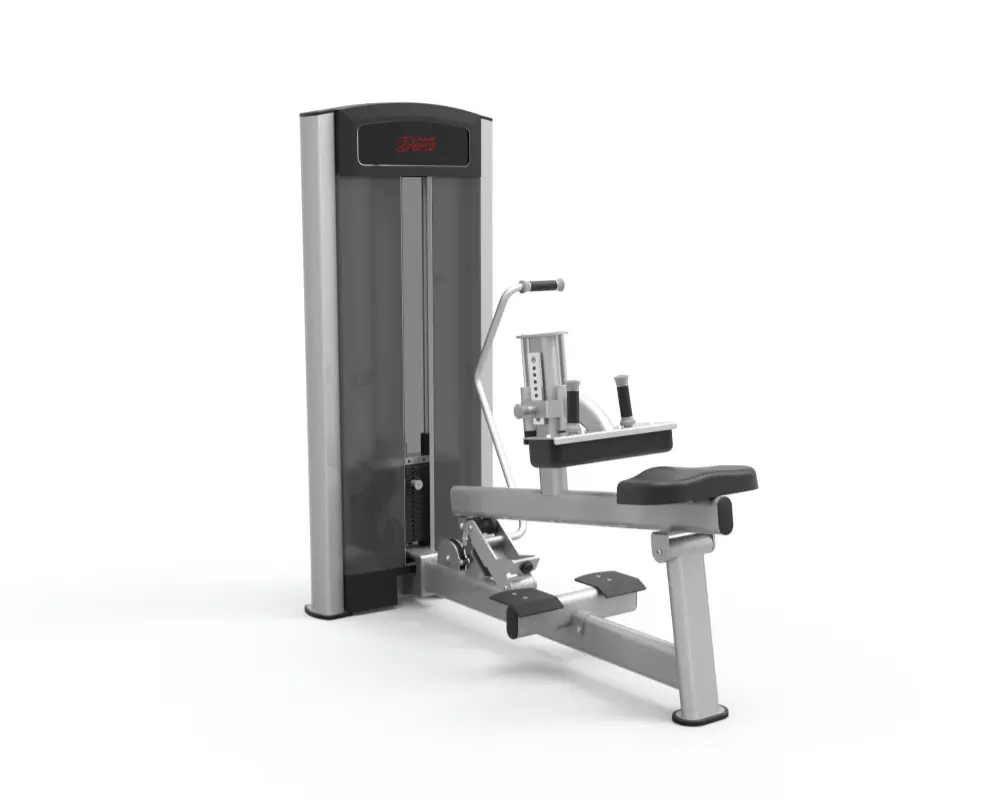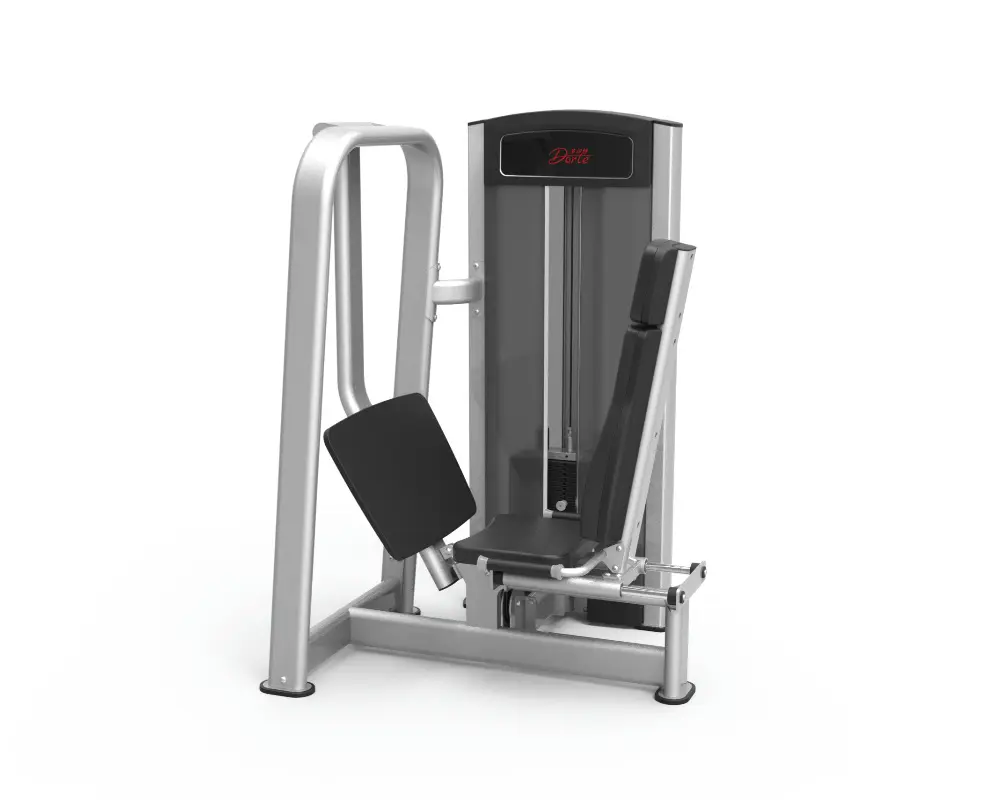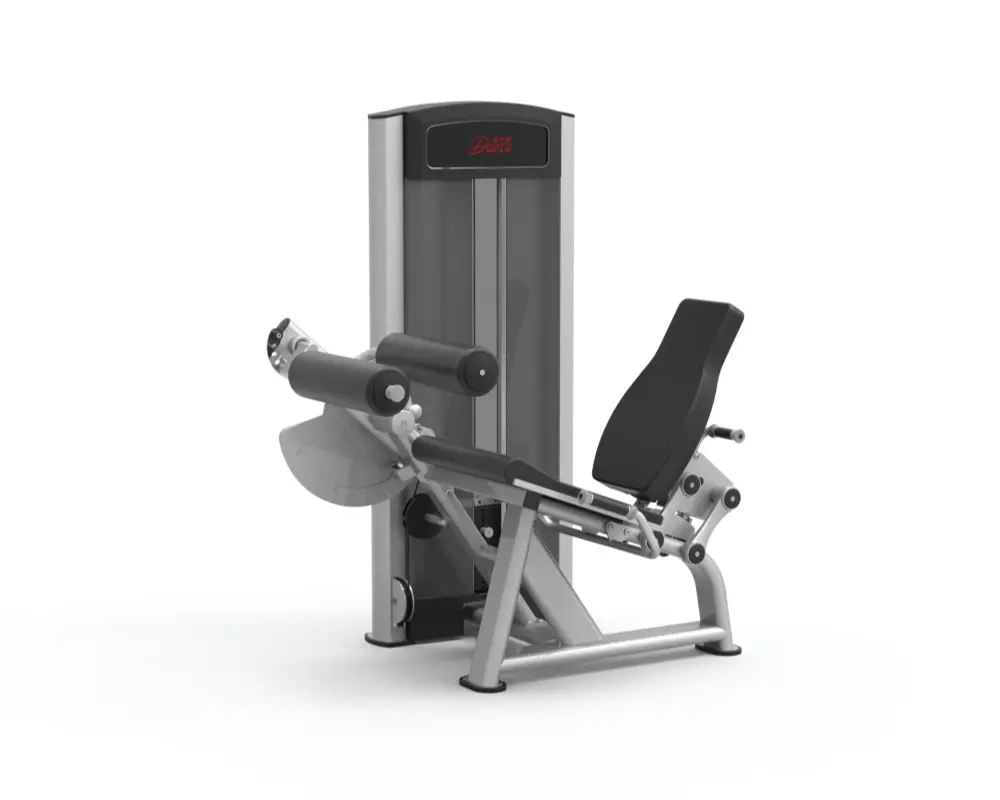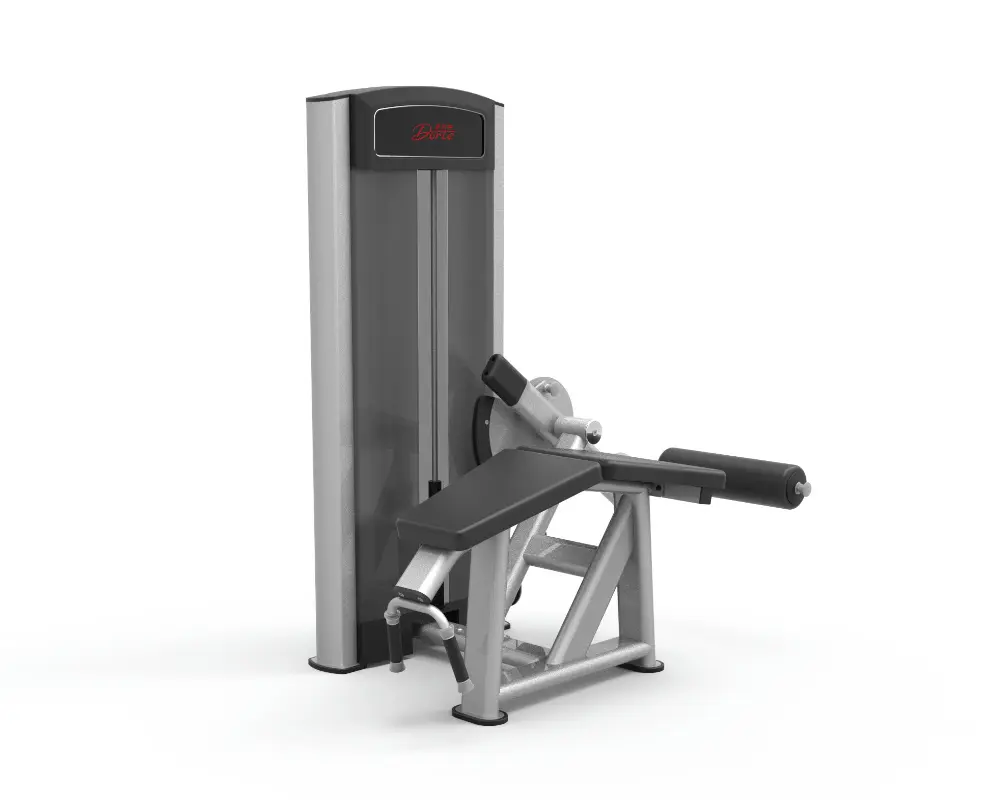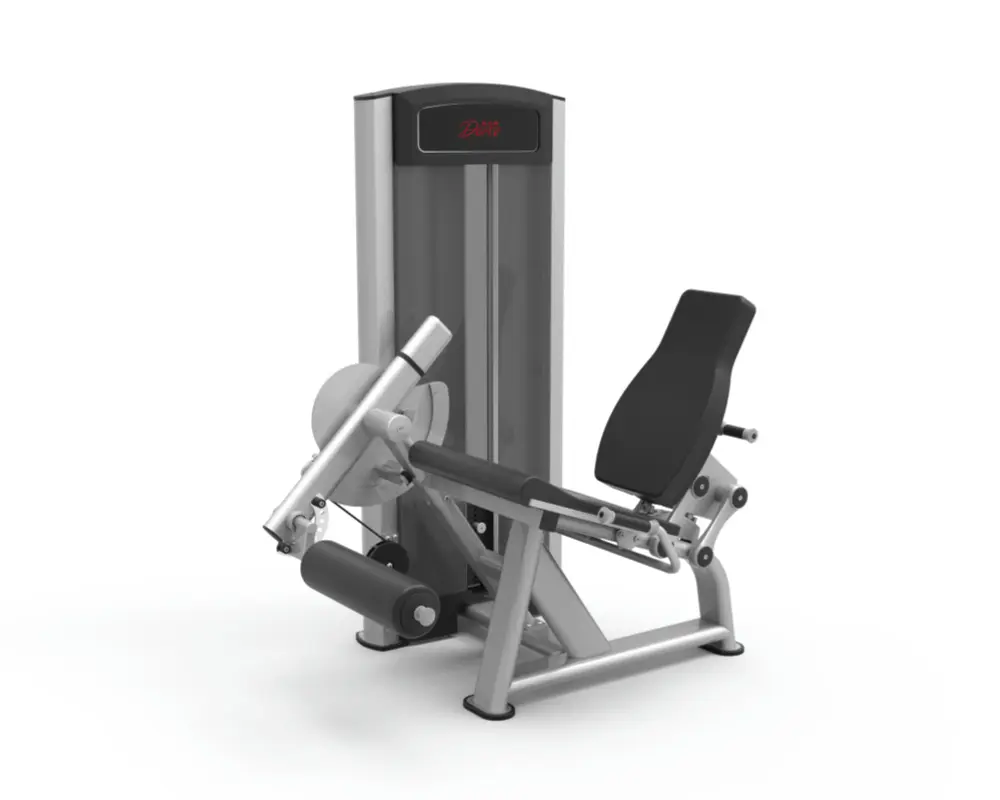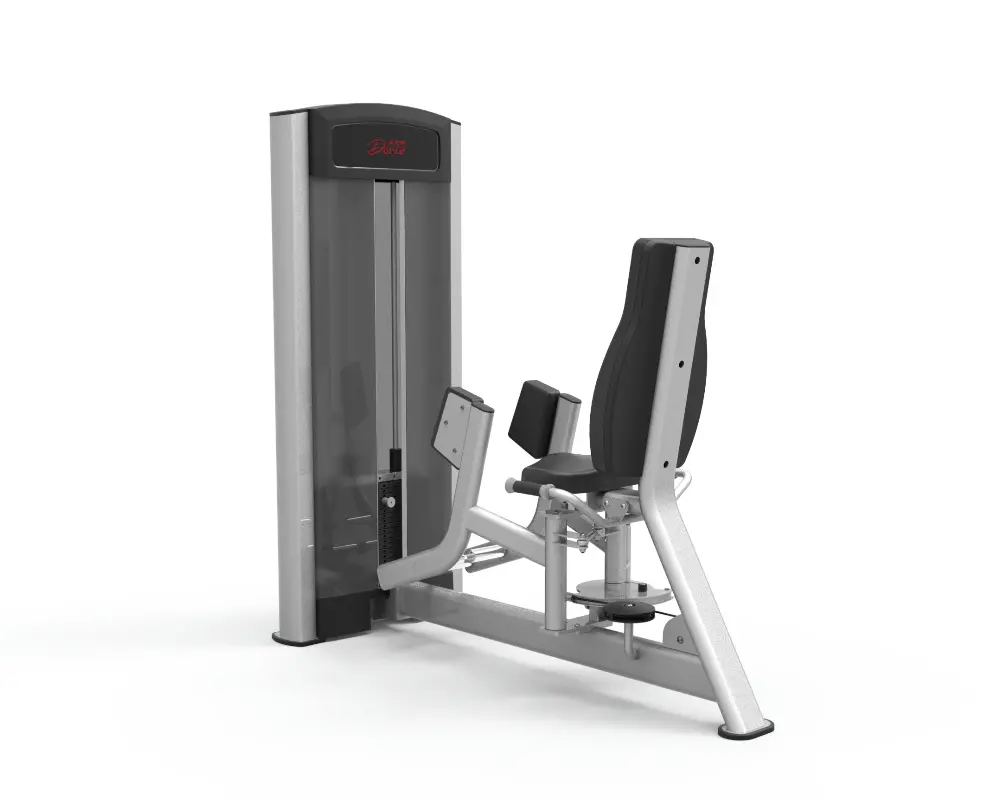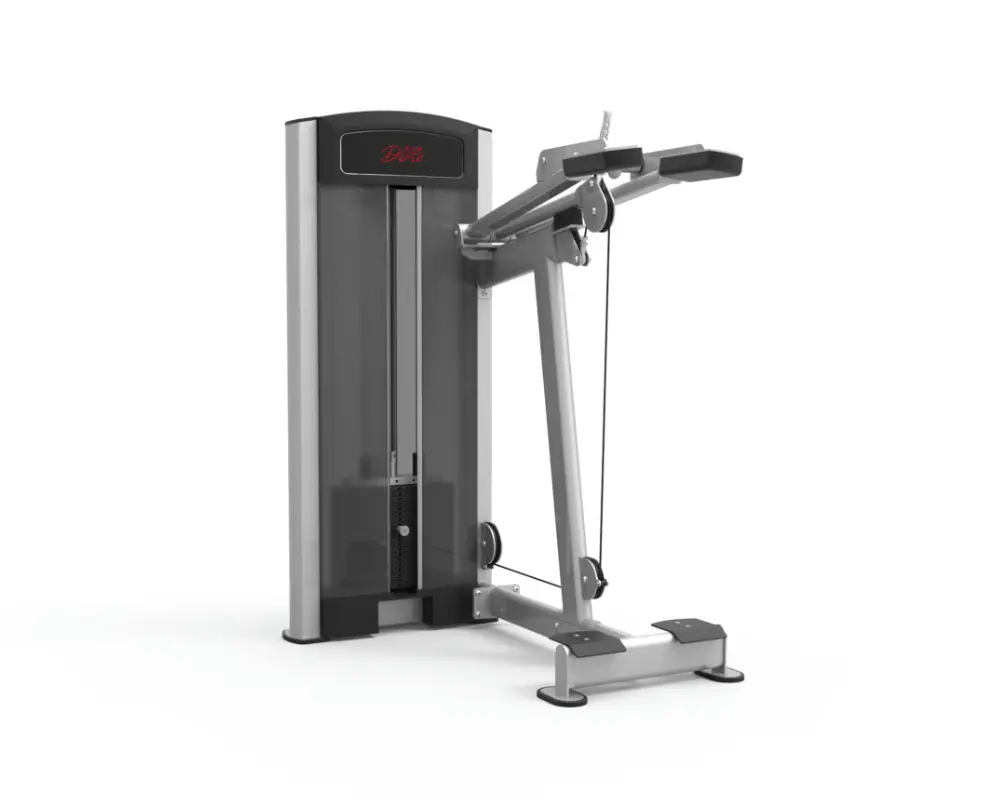

Product Model
| Specification | DL729 |
|---|---|
| Target muscles | Gastrocnemius as the primary target, with the soleus assisting and the knee held straight by the shoulder pads so the gastrocnemius stays at working length |
| Product size | 991*1236*1660mm |
| Counterweight | 100KG |
| Net weight | 210KG |
| Maximum load capacity | 160KG |
| Wire rope tension | more than 1400KG |
| Main frame specification | Q235 steel, 120*75*3.0mm bread-type tube for the main frame; 120*50*3.0mm flat elliptic tube for secondary members |
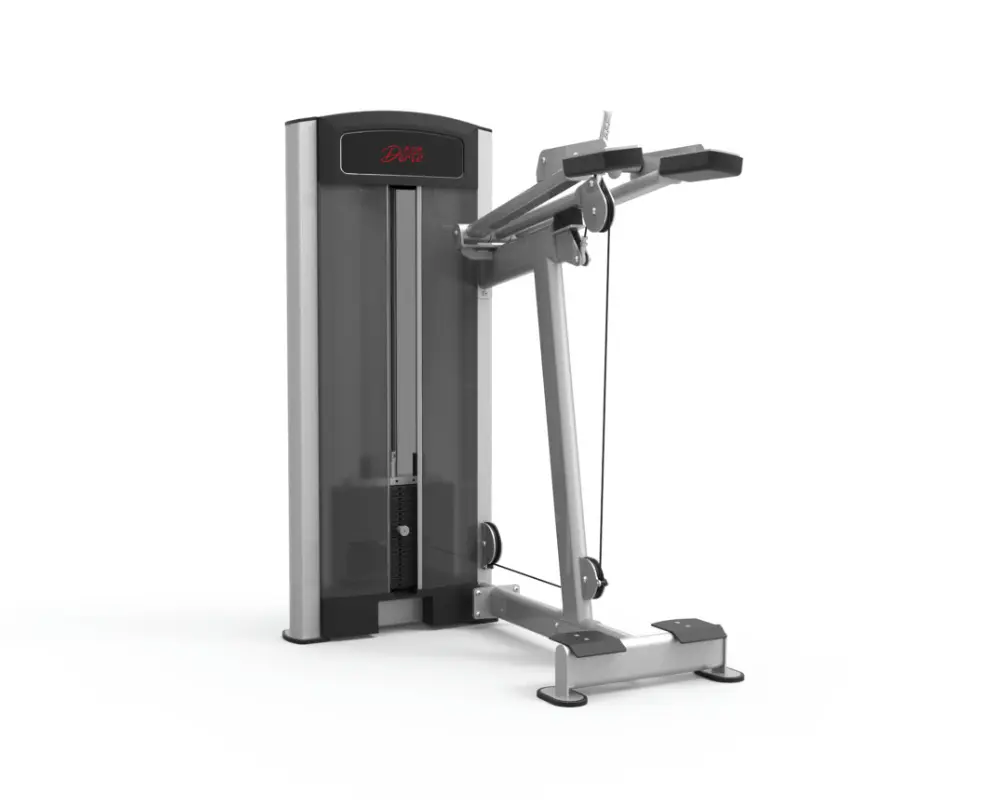
Standing Calf Station
A standing calf raise looks like the simplest machine in the building: stand on a plate, take a weight across the shoulders and go up on the toes. The description is accurate and it hides the one property that decides how the station is programmed, which is that the member stands under a pad that pushes down, so their own body weight is part of the resistance. Nothing else in the leg series works that way.
Follow the two forces. The stack pulls the shoulder pad down; the member's feet push the floor plate down. When the ankle plantar-flexes the heel rises, the whole body rises with it, and the pad rises too, because the member is between them. Total load at the ankle is the pin plus the member — 100 kg on the stack under a 75 kg member is about 175 kg shared between two ankles, or 87.5 kg per side in a single-leg set. On the seated calf station the body weight sits on the seat and never enters the lever, which is the first reason the two stacks cannot be read as a pair.
The second reason is the muscle. 80 kg seated against 100 kg standing reads like a 25% difference in strength; it is a difference between two programmes. The seated station excludes the member and loads a muscle that is roughly 80% slow-twitch; the standing station includes the member and loads one nearer 50 to 60%. Different total load, different fibre type, different repetition range — treating the two figures as comparable produces a purchasing decision about nothing at all.
The shoulder pads do a second job that the name does not advertise. Gastrocnemius crosses the knee, so any bend at the knee shortens it at its upper attachment and hands the work to the soleus. The pads are not there to add load; they are there to hold the knee angle constant, because a member who bends the knee mid-set has quietly changed the exercise. Straight is not the same as locked: a knee driven into hyperextension puts the load into the joint capsule and the posterior structures instead of the muscle, and the cue is tall, not stiff.
The real limit on most members is not strength, it is ankle dorsiflexion. A normal ankle dorsiflexes about twenty degrees; a member who sits for a living, or who has worn raised heels for years, often has less than ten. On a calf raise that shows at the bottom of the range, where a stiff ankle forces the talus forward and closes the space at the back of the joint, and the member feels a pinch rather than a stretch. The fix is two or three centimetres of lift under the forefoot — a plate, a step, a block of timber — not a shorter range, because shortening the range removes the part of the movement the calf most needs.
At 991 × 1236 × 1660 mm the DL729 is wider and shallower than the seated station beside it: 245 mm more wall, 382 mm less depth. The two footprints land at 1.225 and 1.207 m², a difference of 1.5%, which is a fair illustration of how little area tells you about a shape.
Where the Body Weight Goes
210 kg with the stack tower at the top of a 1660 mm frame puts the centre of mass higher than any seated station in the room, and a member standing on one foot under a shoulder pad turns the whole assembly into a lever. Fix it to the floor, or at minimum keep it off a raised floor, a mezzanine or a rubber build-up that can move under load. A seated station that shifts two millimetres is an annoyance; a standing station that shifts two millimetres under a member at full extension is an incident report.
It also asks for headroom in a way the seated station does not. 1660 mm of frame plus a member standing on a raised plate plus the natural rise of the heel means the station wants a 2.4 m soffit at minimum, so it cannot go under a low duct run or the edge of a mezzanine. The entry is vertical too: the member steps up onto the plate with both feet, so the floor in front has to be clear rather than the floor beside. In a room with a low soffit this is the station that gets dropped from the plan first, and it is usually the one that should not be.
Single-leg work is where the station pays for itself. Both legs together let the stronger side carry the weaker through the top of the range without the member noticing; one leg takes the whole pin plus the whole body weight and there is nowhere for a difference to hide. No adjustment is needed between sides, and the shoulder pad keeps the trunk square in a way that a dumbbell held in one hand does not. Expect the first single-leg session to need twenty kilos off the stack, because the working side is now carrying what two sides shared.
Range is the other setting that gets shortened for the wrong reason. The plate is made so the heel can drop below the forefoot at the bottom, which is the only way to load the calf at long length, and members cut it short because the bottom position feels unstable or because their ankle will not travel that far. Hold the bottom for a beat instead of skipping it: the loaded stretch is where the adaptation happens on this movement, and a member who bounces out of it is using the tendon as a spring instead of the muscle as an engine.
Place it within arm's reach of the seated calf station rather than across the room, because the two are programmed as a pair on the same day: heavy standing sets for the gastrocnemius, volume sets seated for the soleus. Together they take 1.737 m of wall and project 1.618 m — 0.532 m more wall than a single seated leg press and less depth than most benches. Same frame family, one colour approval, and a member can finish both in the time it would take to walk between two distant machines.
Fitness Equipment Factory
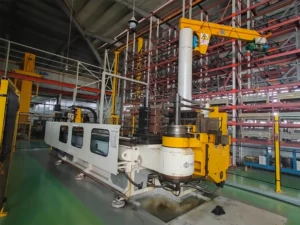
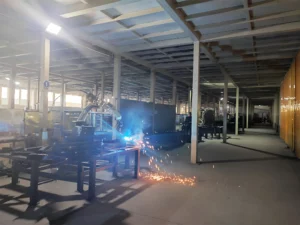
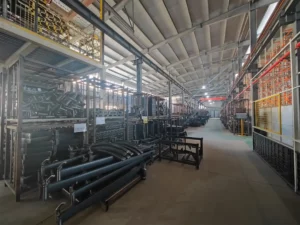
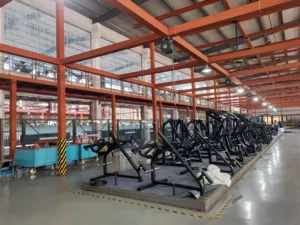
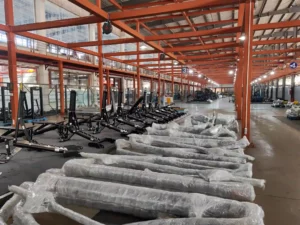
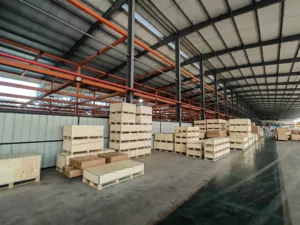
China Ledong offers a comprehensive range of high-quality manufacturing services, from welding and painting to assembly, packaging, and rigorous quality testing, to meet your specific needs. Our experienced team utilizes advanced technology to deliver customized solutions at competitive prices.
Contact now. Get the best solution!
Frequently Asked Questions
Commercial specification, installation and supply questions about the DL729.
Which muscles does the DL729 train?
Gastrocnemius primarily, with the soleus assisting and tibialis posterior and the foot intrinsics stabilising. The knee is held straight by the shoulder pads, which keeps the gastrocnemius at working length — the opposite of the seated station, where a flexed knee shortens it out of the movement. Anyone who needs the soleus trained specifically needs the seated machine as well.
Does body weight count on a standing calf raise?
Yes, and it is the defining difference. The pad presses down on the shoulders, so plantar flexion lifts the pin and the member together and the ankle resists both. A 75 kg member at a 100 kg pin works against about 175 kg, or 87.5 kg per side in a single-leg set. On the seated station the body weight sits on the seat and never reaches the calf, so the two pin readings are not on the same scale.
Why 100 kg here when the seated station has 80 kg?
Because the two stations train different muscles and count different loads. Standing includes the member's body weight and loads a muscle that is roughly half fast-twitch, so it is programmed at eight to twelve heavy repetitions. Seated excludes the body weight and loads a muscle around 80% slow-twitch, so it is programmed at fifteen to twenty-five with tempo. The 25% difference in stack size describes two programmes, not two strengths.
What if a member cannot get the heel down at the bottom?
That is an ankle dorsiflexion limit rather than a calf weakness, and it is common in members who sit for a living. Put two or three centimetres of lift under the forefoot — a plate, a step, a block — so the ankle does not have to travel as far, and keep the full range. Shortening the range instead removes the loaded stretch, which is the part of the movement that does the most work. If the ankle is genuinely restricted and painful, that is a clinical assessment rather than a machine setting.
Should members lock the knees?
No. The knee should be straight and tall rather than driven into hyperextension, because hyperextension puts the load into the joint capsule and the posterior structures instead of the muscle. The shoulder pads hold the angle; the member holds the posture. Watch for the opposite fault as well — a member who bends the knee to get the heel higher has taken the gastrocnemius out and turned the set into a weak soleus set at a worse angle.
Can it be used one leg at a time?
Yes, and it is the station in the room built for it, because one leg takes the whole pin plus the whole body weight and no adjustment is needed between sides. That is roughly double what the same leg carried in a two-leg set, so expect to take twenty kilos off the stack for the first single-leg session. The shoulder pads keep the trunk square while the free leg hangs, which a single-arm dumbbell hold does not.
How much floor space and floor loading does it need?
991 mm by 1236 mm of footprint, with clear floor in front for stepping up onto the plate and about 2.4 m of headroom for a standing member. Net weight 210 kg over 1.225 m² is 171 kg/m², 9% above the seated calf station and 18% below the leg press. The centre of mass sits high, so fix it to the floor or keep it off raised and mezzanine floors.
What foot position should members use?
Ball of the foot on the front edge of the plate with the heel free to drop below it, stance about hip width. Toes straight ahead is the default; a ten to fifteen degree toe-out suits members whose hips rotate outward and does not change which muscle works. What matters is that the forefoot does not slide — a member whose foot creeps back during the set is losing the bottom of the range without noticing.
What warranty and certification apply?
One year on the complete machine, with the shoulder pads and their pivot covered as part of that because they take the full reaction force of a standing member. The unit is manufactured to meet or exceed EN ISO 20957 / EN 957, and we supply the declaration with the shipping documents. We do not hold our own certificate for re-badged units, so we state compliance rather than certification.
What is the minimum order and lead time?
10 units per order in total, with no per-model minimum, so one DL729 plus nine other machines is a valid order, and pairing it with the DL728 keeps one frame width, one colour approval and one spare-parts set. Regular production runs 25–35 days to Shenzhen port excluding ocean freight; custom colour or branding runs 35–45 days. FOB Shenzhen, payment before shipment, and the packing list and installation sequence go out before the container leaves.