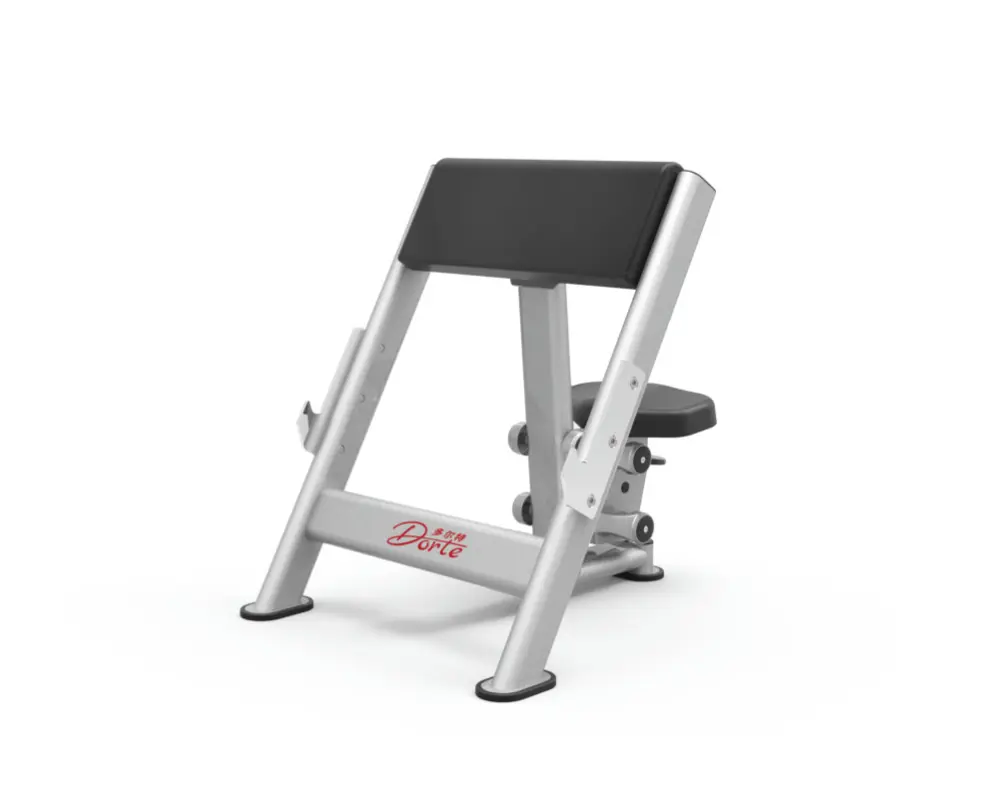

Product Model
| Specification | DL734 |
|---|---|
| Target muscles | Biceps brachii as the primary target, with brachialis contributing through the whole range and brachioradialis taking a larger share once an EZ bar replaces a straight one |
| Product size | 800*957*946mm |
| Counterweight | None - the station takes a barbell or EZ bar, supplied separately |
| Net weight | 60KG |
| Maximum load capacity | 160KG (user rating - the resistance is the bar, not the frame) |
| Main frame specification | Q235 steel, 120*50*3.0mm flat elliptic tube |
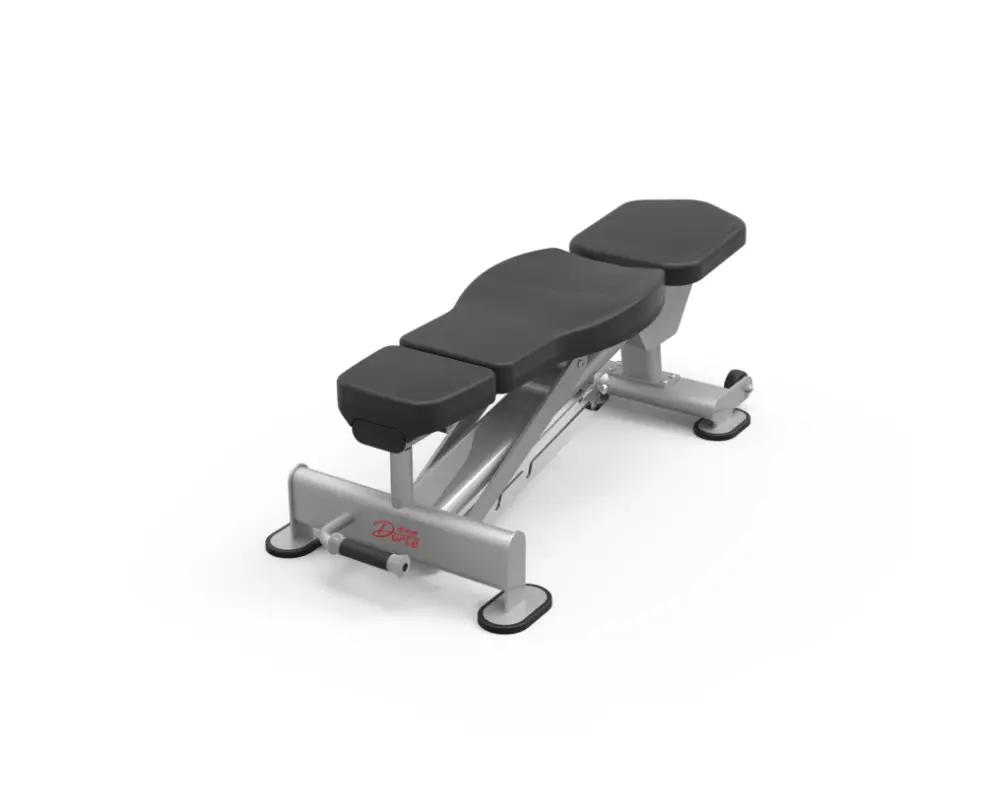
| Seat | One-piece foam with PU leather cover on an aluminium alloy arm, four-bar linkage, torsion-spring assisted height adjustment |
| Resistance source | Not included - set by the barbell or EZ bar and plates available on site |
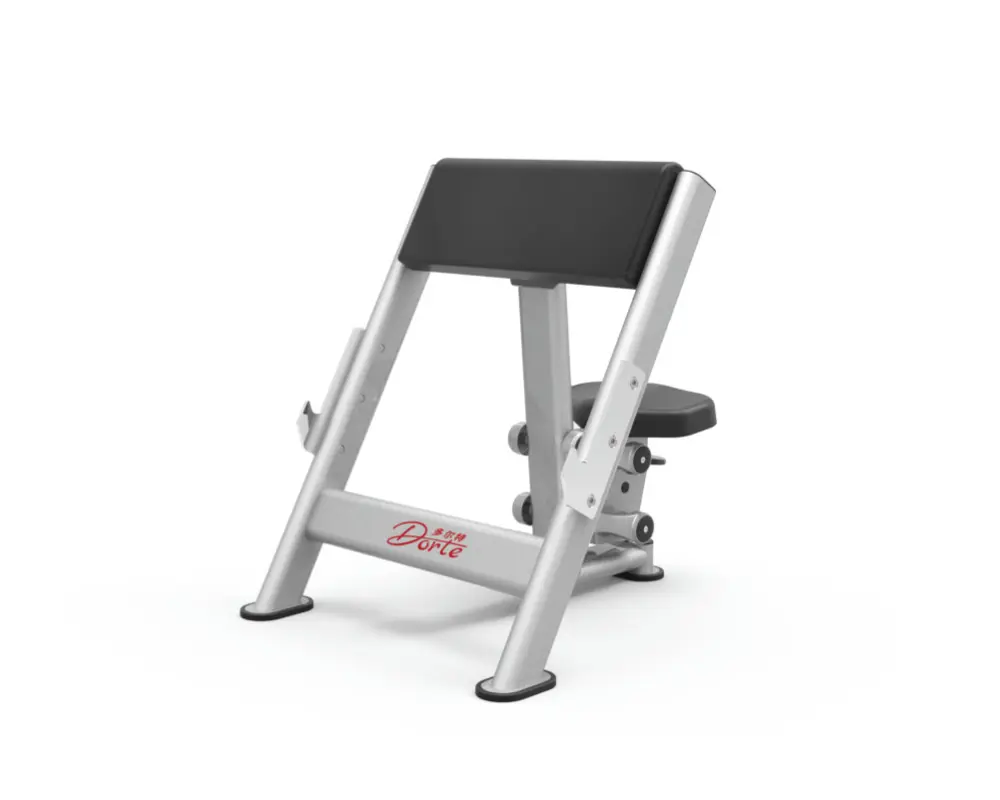
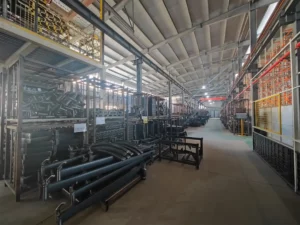
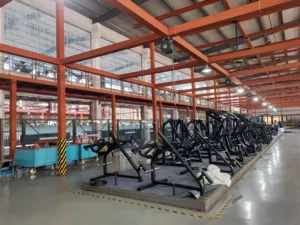
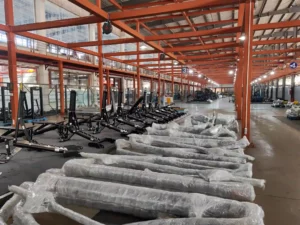
DL734 is cycled through the full seat range on the line with the upper-arm pad checked at both ends, because a linkage that only fits the mid-range height passes a visual inspection and fails the first tall member who sits on it.
Ask for the DL734 linkage travel and the seat height range
Same Exercise, 190 kg of Machine or 60 kg of Frame
The range already had a biceps station before this one, and the two do the same job with a factor of three between their weights. The DL708 curl machine is 190 kg of frame carrying a 60 kg stack. The DL734 is a 60 kg frame that carries nothing until you put a bar on it. On paper that reads as the cheaper answer to the same question, and the difference is worth being precise about.
It is not a lighter machine. It is a machine that has outsourced its resistance. The 250 kg that the DL708 has and this one does not are the stack, the tower, the two pulleys, the cable and the selector pin — everything that turns a pin position into a load at the handle. The DL734 replaces all of it with the bar already in the room, and that is a trade rather than a saving.
The measurements follow from it. 1053 × 1150 mm against 800 × 957 mm is 1.211 m² against 0.766 m², a difference of 58%. 1660 mm tall against 946 mm gives 714 mm of height back to the room. Net weight 190 kg against 60 kg takes floor loading from 157 kg/m² down to 78 kg/m², which is the difference between needing a beam under it on an upper floor and not thinking about the slab at all.
What the bar buys is also what it costs. A stack moves in five-kilogram steps and a selector pin lets a member drop one step between sets. Plates move in steps of 2.5, 5 or 10 kg depending on what is on the rack, and the member has to stand up to change them. A station that needs a bar to work is a station whose programme depends on the bar being within reach.
The structural side is the part that never shows on a specification sheet. A stack machine carries its resistance inside its own tower, so the frame only has to hold the member and the arm. Here the resistance arrives from outside the frame, on a lever, and the frame has to resist it without a tower counterweighting the back. That is why the base is wider than the seat and why the load path runs forward of the hips rather than down through them.
Which of the two a room wants depends on a question that has nothing to do with either machine: who loads the bar. Where members train unsupervised and the goal is turnout, the stack wins because it asks nothing of them. Where there is a free-weight area, a coach, or a rack of plates already against the wall, the 60 kg frame delivers the same exercise with 130 kg less steel on the floor and 714 mm more headroom.
The Four-Bar Linkage Is What Fits 1.55 m and 1.90 m
The hard problem in a seated curl station is not the resistance. It is keeping the upper-arm pad in the same place relative to the elbow when the seat moves. Get it wrong and the station only serves the members whose height the designer happened to use as a reference.
A straight sliding seat shows the failure clearly. Raise it for a shorter member and the pad rides up with the seat, so the armpit ends above the pad and the upper arm has nothing to brace against at the top of the range. Drop it for a taller member and the pad lands on the forearm instead of the upper arm, which turns the movement into a partial curl around a hinge that is no longer where it was designed to be. Across the 350 mm between a 1.55 m and a 1.90 m member, a fixed pad does not cover both.
The four-bar linkage is the mechanical answer. Four pivots and two floating links let the pad translate and rotate by different amounts as the seat rises, so the elbow keeps the same relationship to the pad throughout the adjustment range instead of inheriting the seat's travel. That is the whole point of the geometry: not rigidity, but decoupling the pad from the seat.
The aluminium alloy arm carrying the pad is part of the same job. Aluminium here is not a weight-saving trick — it keeps a moving link light enough for a member to move while seated and stiff enough that the pivot does not feel like it has a step in it. The torsion spring on the adjustment takes the last part of the load off the member's hand, which is why the seat can be raised without pulling a pin out first.
That adjustment is what separates a commercial station from a bench with a pad on it, and it can be tested in about ninety seconds with no tools. Sit down, raise the seat to its top position and check whether the armpit is still on the pad; then drop it to the bottom and check whether the pad has moved off the upper arm onto the forearm. If either end fails, the linkage is a straight slide with a parallelogram sticker on it, and the members at the ends of the height range will use the station once.
No Stack: the Resistance Comes From the Room
This station has no weight tower, so its resistance ceiling is set by something outside its own specification sheet: the heaviest bar in the building. A gym with a single 20 kg fixed barbell has a 20 kg biceps station. A gym with an Olympic bar and a plate tree has whatever the member can load. The machine does not change; the room around it does.
The bar matters as much as the plates. The frame is 800 mm across, so a 1200 mm EZ bar sits inside it comfortably, with the bends clear of the pad and the ends outside the member's knees. A 2200 mm Olympic bar also fits and is what most rooms already own, but the sleeves then project far enough past the frame that loaded plates sit where the member's elbows travel — workable, and less tidy to use than the shorter bar the station was drawn around.
Plate position decides whether the station gets used at all. A member curling to failure does not walk across the room between sets, so the plates have to be within a step or two of the seat, at hand height rather than on the floor. This is the one installation decision that reliably turns a good station into an ornament, and it costs nothing to get right at the layout stage.
The trade against a stack is granularity. A selectorised machine offers five-kilogram steps and a member can drop one for a back-off set. Plates jump by 2.5, 5 or 10 kg per side, so progression is coarser and the smallest increment is a pair of collars. For biceps work, where total load is low and sets are long, that coarseness bothers a novice more than it bothers anyone else.
What the missing tower gives back is service life. Cable, pulley, selector pin and guide rod are the four parts that fail on a stack machine, and every one of them needs a technician. Remove them and what is left to wear is a leather pad, a pivot bushing and a torsion spring — items a member cannot break by using the station correctly. Sixteen years of supplying both types has made the pattern hard to miss: the repair calls are almost always about a cable, and almost never about a frame.
Frequently Asked Questions
Resistance source, seat adjustment, placement and supply questions about the DL734.
Which muscles does the DL734 train?
Biceps brachii primarily, because the pad fixes the upper arm and removes the shoulder flexion that would otherwise let a member swing the weight up. Brachialis works through the whole range, since it crosses the elbow alone and cannot be taken out of the movement by a change of shoulder angle. Switch from a straight bar to an EZ bar and brachioradialis takes a larger share, because a semi-pronated grip does not shorten it the way a fully supinated one does.
Why is the frame only 60 kg?
Because the resistance is not inside it. On a selectorised curl machine the frame has to carry a tower, a 60 kg stack, two pulleys and a guide rod, and that assembly is most of the 190 kg the DL708 weighs. Here the load arrives on a bar the member loads, so the frame only has to hold the member, the pad and a pivot in the right place — which 60 kg of Q235 does.
Does it need to be bolted to the floor?
No. At 60 kg on an 800 mm base it stays where it is put during normal use. Two things are still worth doing: fit rubber pads under the feet so the frame does not creep on a smooth rubber floor as the member's weight shifts forward through each repetition, and keep it off any slope or levelling ramp. Where the station sits on a removable platform, check it after the first week and then treat it as settled.
Can one person move it?
Yes, and that is a property rather than a footnote. At 60 kg with no tower the frame can be carried by two people without dismantling anything, and slid by one on a smooth floor. Rooms that repurpose a floor between seasons do this every year — the station that can be moved is the station that survives a layout change instead of being written off.
What bar should be used with it?
A 1200 mm EZ bar is the closer match for the 800 mm frame: the bends sit clear of the pad and the ends stay outside the member's knees. A standard 2200 mm Olympic bar fits and is usually already on site, but its sleeves project far enough past the frame that loaded plates sit in the path the elbows travel through. Whichever is used, the collars belong on the bar rather than loose on the plate tree.
How does the seat height adjust?
With a torsion-spring assisted mechanism on a four-bar linkage, so the seat rises without a pin being pulled and without the member standing up. The spring carries enough of the load that the adjustment can be made one-handed while seated, which is the point: a member who has to fetch a technician to change height will use one setting for everyone.
How much floor space and floor loading does it need?
800 × 957 mm of footprint, which is 0.766 m², with about 0.6 m clear in front for the knees and the bar ends. Net weight 60 kg over that area is 78 kg/m² — half the 157 kg/m² of the DL708 and the lightest of any loaded strength station in the range, so it is the easiest thing on the floor to place over a suspended slab.
Where can it go that other stations cannot?
At 946 mm tall it is 714 mm lower than a selectorised station. That puts it under a window sill, on a stair landing, against a wall where a duct drops to 1100 mm, or in a mezzanine conversion with 1200 mm clear — all places where nothing with a tower will stand. It also means a member seated beside it can see over it, which matters in a small room.
What warranty and certification apply?
One year on the complete unit, with the upper-arm pad, linkage and torsion spring covered as part of that because they are the parts that move. The station is manufactured to meet or exceed EN ISO 20957 / EN 957, and we supply the declaration with the shipping documents. We do not hold our own certificate for re-badged units, so we state compliance rather than certification.
What is the minimum order and lead time?
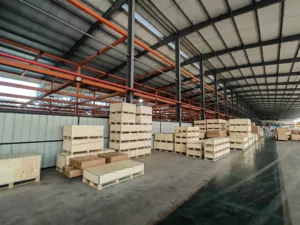
10 units per order in total across the range, with no per-model minimum, so one DL734 plus nine other stations is a valid order and a room can be kitted in one colour on one spare-parts set. Regular production runs 25 to 35 days to Shenzhen port excluding ocean freight; custom colour or branding runs 35 to 45 days. FOB Shenzhen, payment before shipment, and we send the packing list and the assembly sequence before the container leaves.