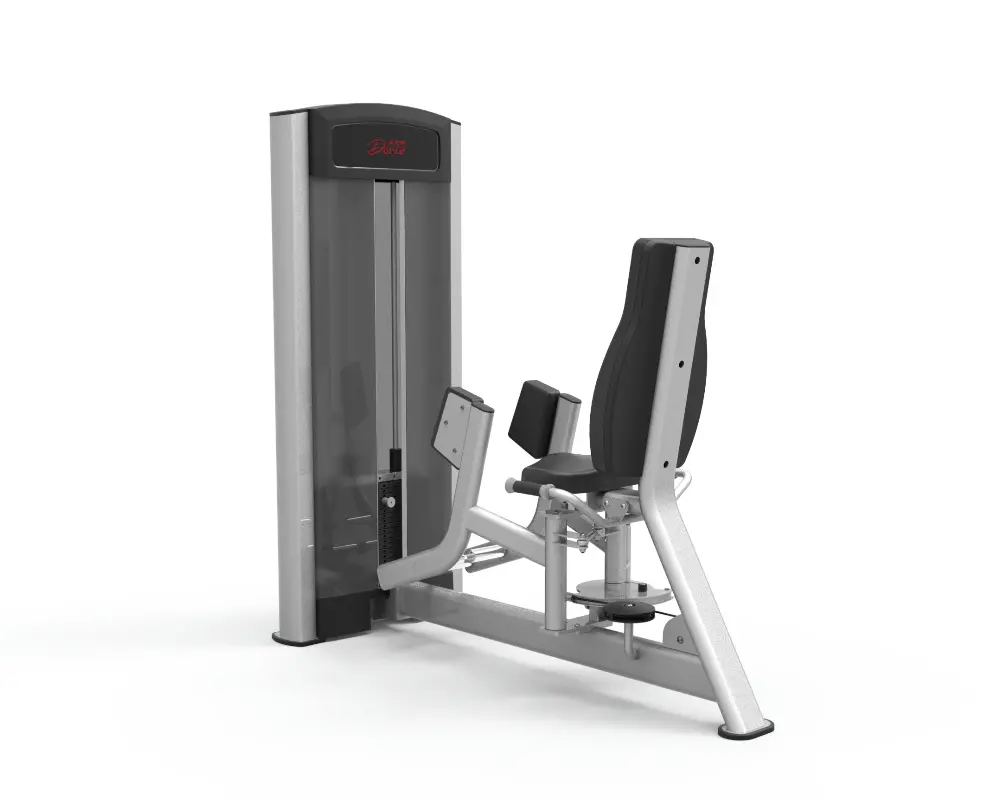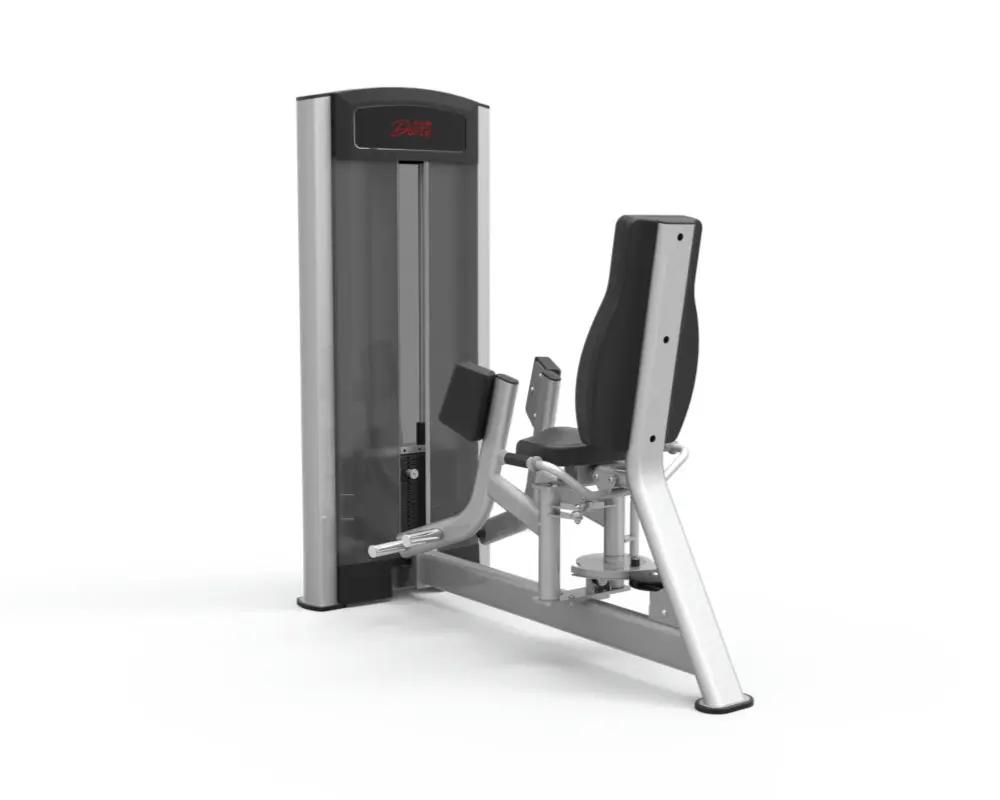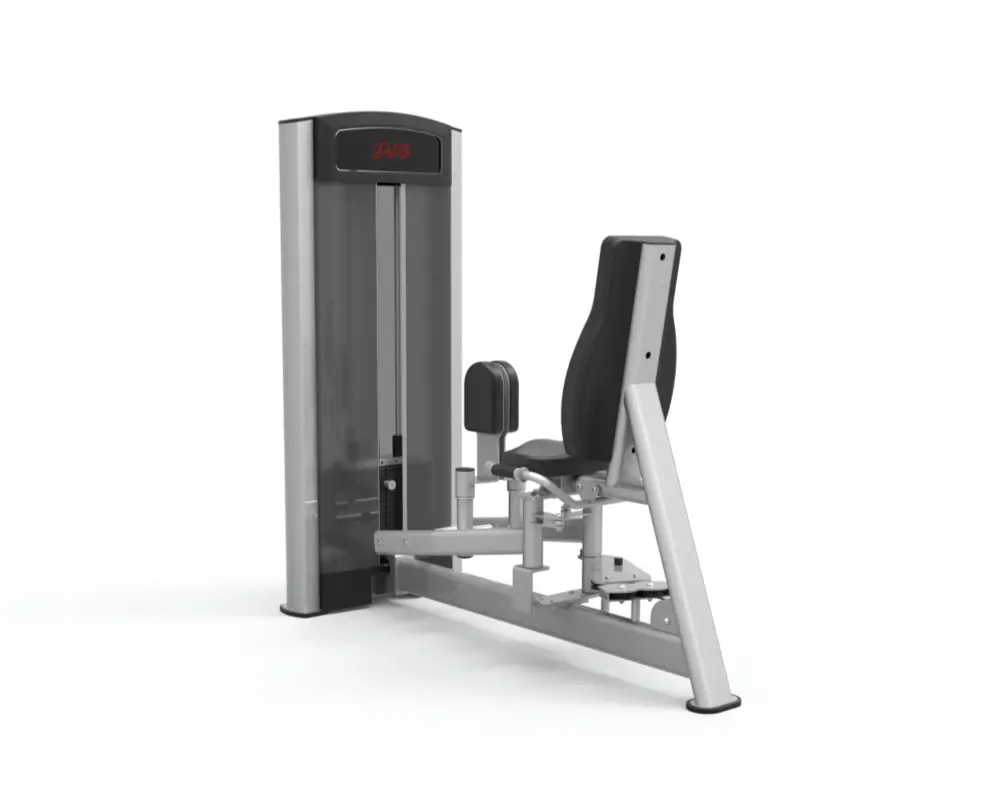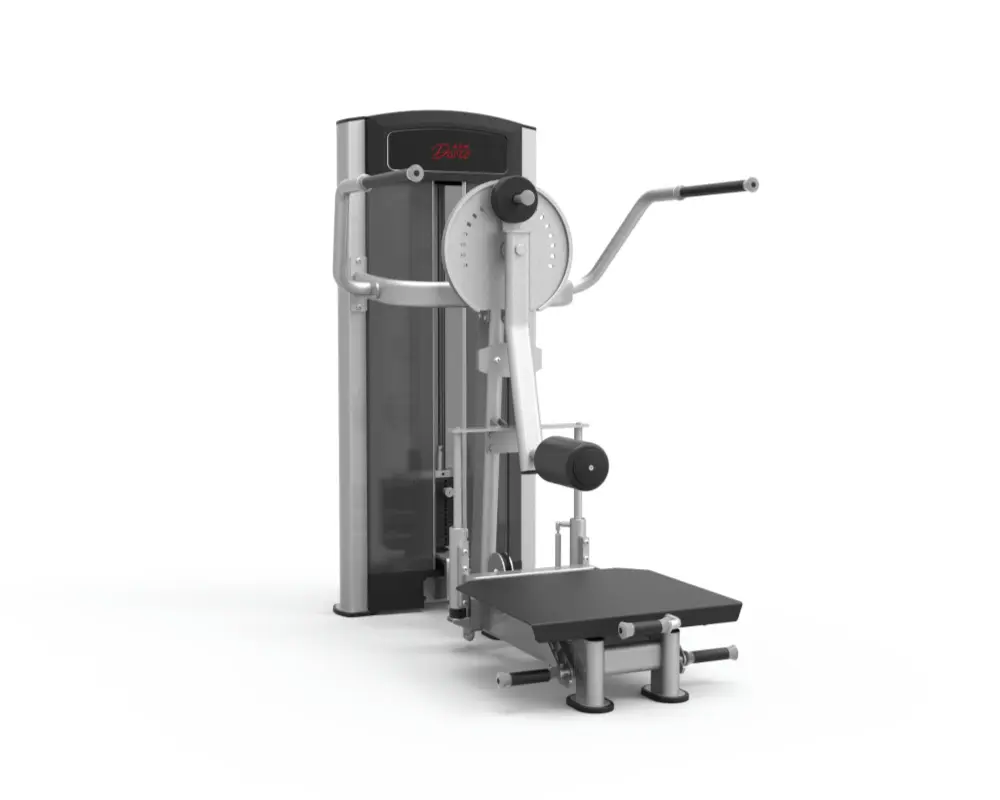

Модель продукта
| Спецификация | DL724 |
|---|---|
| Целевые мышцы | Quadriceps femoris - rectus femoris, vastus lateralis, vastus medialis, vastus intermedius |
| Размер продукта | 1322*1053*1660mm |
| Противовес | 80КГ |
| Вес нетто | 220KG |
| Максимальная нагрузка | 160КГ |
| Натяжение троса | более 1400KG |
| Спецификация основного каркаса | Сталь Q235, профильная труба типа «хлеб» 120*75*3.0 мм для основной рамы; плоская эллиптическая труба 120*50*3.0 мм для вторичных элементов |
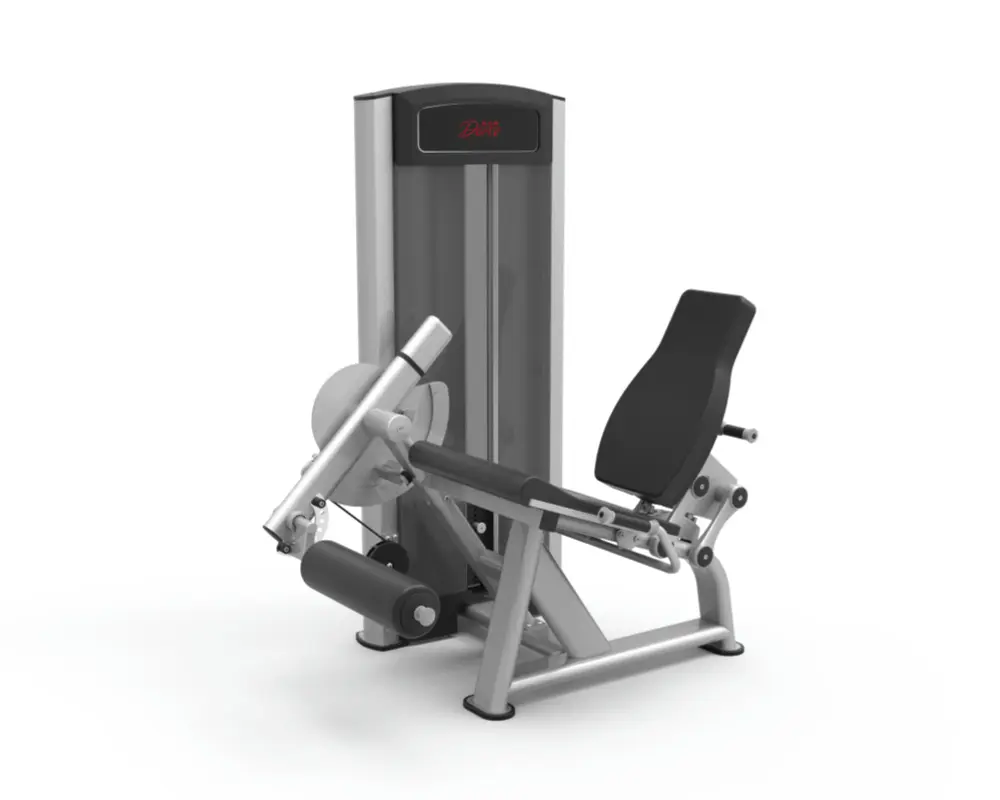
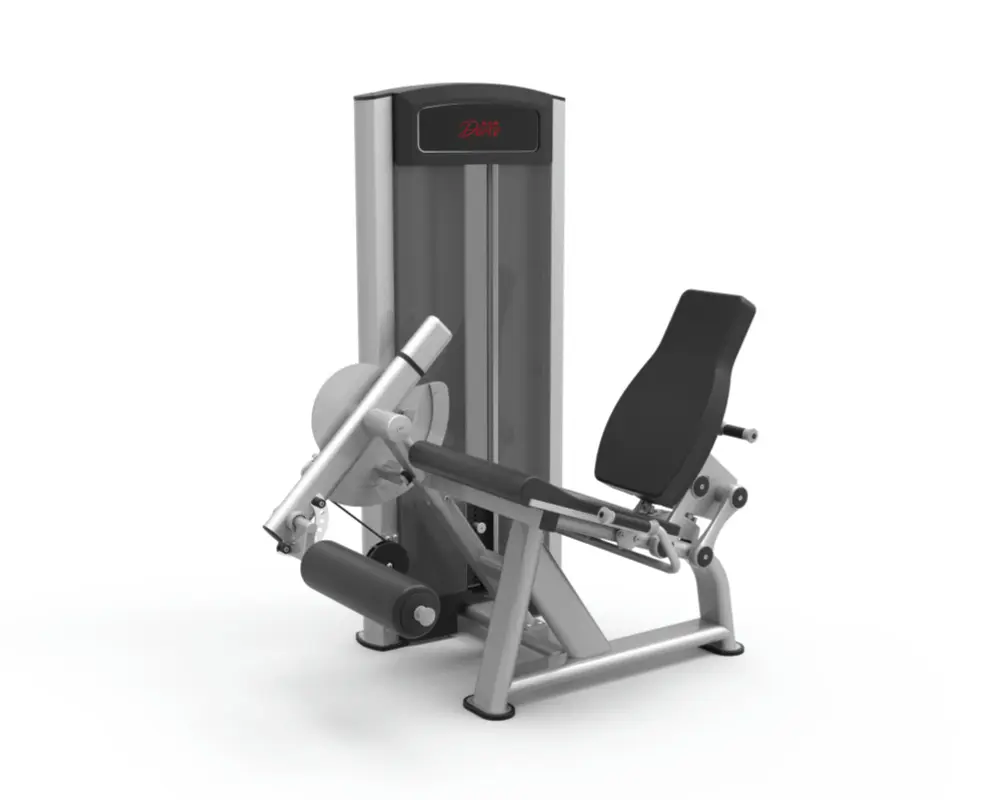
Seated Knee Extension Station
The DL724 does one thing: it extends the knee against resistance, from a seated position with the back supported and the pelvis held. That reads like a narrow brief. It is the only brief on a commercial floor that isolates the quadriceps, because every other leg movement in the room is a two-joint movement that lets the hip take part of the load.
Squat, leg press, lunge and step-up all extend the knee and the hip at the same time. When the hip extends, the rectus femoris shortens at its upper attachment, and the load at the knee drops exactly where a trained member is strongest. The DL724 takes the hip out of the equation: the seat and back pad hold the pelvis, the ankle pad holds the shin, and the resistance stays on the quadriceps through the whole arc. That is what isolation means in mechanical terms, and it is why a member can move 40 kg on a leg press and still fail at 25 kg here.
One objection comes up in every specification meeting, so it belongs in the specification rather than in a sales call: open-chain knee extension loads the anterior cruciate ligament. Tibial translation peaks near 30 degrees of knee flexion, which is why a protocol after ACL reconstruction usually keeps open-chain work inside a restricted band and away from the terminal 0–30 degrees. That is a real constraint for a clinic. It is not a constraint for a corporate fitness room, a hotel gym or a five-a-side squad, because the members using the station are not six months out of a reconstruction. The station is not the risk; unsupervised end-range loading on a healing graft is.
The second objection is more interesting, because it is built into the geometry of every seated leg extension. The rectus femoris crosses the hip as well as the knee, so a seat set at 90 degrees of hip flexion puts that head into a shortened position before the set even starts, and a shortened muscle cannot produce the force it produces at resting length. The answer is back pad angle, not a bigger stack. Reclining the back pad lengthens the rectus femoris and buys force at the top of the range, at the cost of more pressure on the lumbar pad. On the DL724 the back pad angle and the seat depth both adjust, and that pair of settings is what a coach changes for a member who cannot finish the last 20 degrees.
The stack is 80 kg, and the figure that matters is not 80 but the torque it produces at the joint. The ankle pad sits roughly 0.35 m from the knee axis, so 80 kg at the pad is about 275 N·m of knee extension torque. That is the same order as a 100 kg back squat, where the load is split across two legs and the hip produces most of the moment. Members who read the plate and conclude that 80 kg means a light station are reading the wrong number; what the plate measures is mass, and what the knee sees is torque.
Frame is Q235 steel: 120 × 75 × 3.0 mm bread-type tube for the main structure, 120 × 50 × 3.0 mm flat elliptic tube for the secondary members. The wire rope is rated above 1400 kg against a 220 kg machine carrying a 160 kg member, a margin of roughly six to one, which is why the cable is not the service item on these units. Seat and back pad are one-piece foam with a PU leather cover, mounted on an aluminium parallelogram arm with torsion spring assist, so an angle or height change is one-handed and the pad face stays parallel through the travel instead of rotating as it rises.
At 1322 × 1053 × 1660 mm the DL724 is the widest and the shallowest station in this range. It is 77% wider than the DL722 adductor and 37% shallower than it. Both numbers are deliberate, and the rest of this page is about what they cost and what they buy.
Why It Is Wide and Shallow
Set the DL724 beside the hip machines and the footprint reads wrong at first glance. 1322 mm wide against 746 mm, 1053 mm deep against 1664 mm. The station that trains the largest muscle group in the leg takes less depth than the stations that train the smallest ones.
The reason is the arc. Hip adduction and abduction are side-to-side movements: the member sits facing along the machine and the leg swings laterally, so the frame has to carry the seat, the back pad and the stack in a line, and that line is where 1664 mm comes from. Knee extension is a forward movement on a short radius. The knee axis sits under the seat, the ankle pad sweeps an arc of about 0.7 m, and the entire movement finishes inside the machine's own depth. No part of the DL724 travels outside the 1053 mm.
That changes where the machine belongs on a plan. Against a wall it claims 1.322 m of wall and projects 1.053 m into the room. The DL722 claims 0.746 m of wall and projects 1.664 m. A room with a long wall and a shallow depth — the usual shape of a converted office floor or a hotel function room — takes the DL724 easily and fights the hip machines. A narrow room with deep bays does the opposite. One DL724 plus one DL722 plus one DL723 needs 2.814 m of continuous wall and never projects more than 1.664 m.
Floor loading is where a specification sheet misleads most often. The DL724 weighs 220 kg over 1.39 m², which is 158 kg/m². The DL722 weighs 200 kg over 1.24 m², which is 161 kg/m². The heavier machine loads the slab less, by 1.9%. Anyone arguing that the leg extension has to stay on the ground floor while the hip machines go upstairs is arguing from the weight figure instead of the footprint, and on these two units the two figures point in opposite directions.
Allow 0.7 m in front of the ankle pad for getting on and off, and keep the pad side away from a mirror or a glass partition: a member finishing a set drops the shin, and the ankle pad lands exactly where a mirror is. Behind the machine the stack needs the normal 100 mm service gap and nothing else, so the back can go against a wall, a column or the end of a run.
Set-up decides whether the station gets used, more than placement does. The ankle pad belongs on the lower shin just above the ankle joint, not across the top of the foot, which is where most members put it and which turns the movement into a toe press with a fraction of the range and none of the load at the knee. The knee axis has to line up with the pivot, so seat depth changes when a taller member sits down. Both adjustments are on the machine, and a room that demonstrates them once in the first week keeps the station busy for years; a room that does not ends up with a station only three members know how to use.
One ordering note, because it is the question that decides single versus pair. Knee extension and seated leg curl are the two halves of the same joint and they should be bought together or not at all — a room with the extensor side and no flexor side builds an imbalance it then has to correct. The leg curl is the DL725 on the same platform and the same colour approval, and ordering them on one purchase order keeps one spare-parts set and one installation sequence.
Завод по производству оборудования для фитнеса
China Ledong предлагает полный спектр высококачественных производственных услуг, от сварки и покраски до сборки, упаковки и тщательного тестирования качества, для удовлетворения ваших конкретных потребностей. Наша опытная команда использует передовые технологии для предоставления индивидуальных решений по конкурентоспособным ценам.
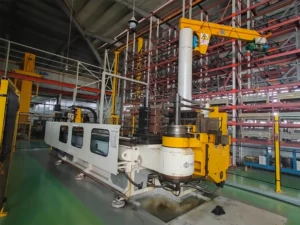
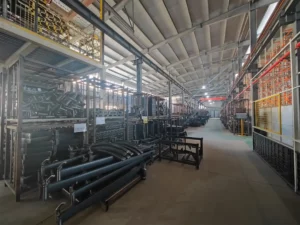
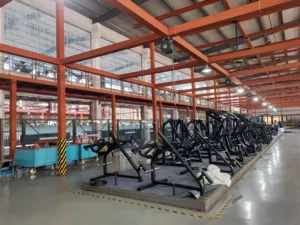
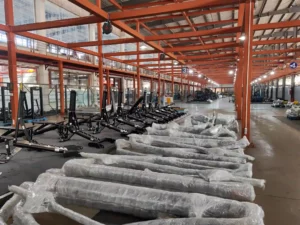
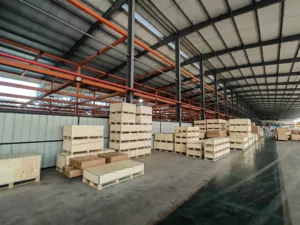
Свяжитесь сейчас. Получите лучшее решение!
Часто задаваемые вопросы
Commercial specification, installation and supply questions about the DL724.
Какие мышцы тренирует DL724?
Все четыре головки квадрицепса: прямая мышца бедра, латеральная широкая мышца, медиальная широкая мышца и промежуточная широкая мышца. Медиальная широкая мышца выполняет последние 15 градусов разгибания и является той головкой, которая у большинства занимающихся отстаёт в развитии, поэтому терминальная амплитуда важнее величины отягощения. Задняя поверхность бедра и ягодичные мышцы стабилизируют таз, но в этом движении не тренируются.
Вредно ли разгибание колена в открытой кинематической цепи для коленного сустава?
Это создаёт нагрузку на переднюю крестообразную связку, и об этом стоит сказать прямо. Смещение большеберцовой кости достигает пика при сгибании колена около 30 градусов, поэтому восстановленное колено должно оставаться в ограниченном диапазоне в первые месяцы, и это решение принимает лечащий врач, а не тренажёрный зал. Для всех остальных — обычных членов клуба, школьных спортсменов, гостей отеля — нагрузка является прогрессивной, контролируемой и прикладывается к суставу, который тренируют, а не реабилитируют.
Почему только 80 кг, когда члены приседают больше?
Потому что эти два числа несопоставимы. 80 кг на подушке для голени, на расстоянии 0,35 м от оси колена, — это примерно 275 Н·м момента разгибания. Приседание со 100 кг распределяет нагрузку на две ноги и позволяет тазобедренному суставу создавать большую часть момента. На практике 80 кг — это больше, чем большинство посетителей могут использовать для контролируемого подхода из десяти повторений, и именно шаг в 5 кг позволяет посетителю прогрессировать неделя за неделей, а не перескакивать через точку, в которой адаптируется сухожилие.
Действительно ли угол наклона спинки изменяет упражнение?
Это меняет, какая головка выполняет работу. Прямая мышца бедра пересекает тазобедренный сустав, поэтому полностью вертикальное сиденье укорачивает её ещё до начала подхода; наклон спинки удлиняет её и восстанавливает усилие near full extension, ценой большего давления на поясничную подушку. Тренер, настраивая клиента, который застревает за 30 градусов до полного разгибания, обычно наклоняет спинку на два положения, прежде чем трогать фиксатор.
Можно ли использовать его по одной ноге за раз?
Да, и для всех, у кого есть разница между сторонами, это лучший способ использования. Рама и стек 80 кг рассчитаны на одностороннюю нагрузку без противовеса, и односторонняя работа на этой станции выявляет разницу, которую полностью скрывает двусторонний подход. Именно так станция используется в программах восстановления после травм, когда одна сторона допускается к нагрузке раньше другой.
Сколько площади на полу ему действительно нужно?
Площадь основания 1,322 м на 1,053 м, плюс около 0,7 м перед подушкой для голени для захода и выхода. Ничего не выходит за эти пределы. Это самый малогабаритный тренажёр в линейке по глубине, поэтому он устанавливается к стене с зазором 100 мм и занимает то же пристенное пространство, что и жим ногами.
Стоит ли размещать в корпоративном зале площадью 100 м²?
Это одна из четырёх стоек для ног, которые оправдывают своё место при таком размере, наряду с жимом ногами, тренажёром для сгибания ног сидя и одним тренажёром для бёдер, поскольку она не требует страхующего, одной демонстрации и около двух с половиной минут времени члена клуба. Зал, в котором всего пять тренажёров для ног, обычно отводит один из них сюда, а не добавляет второй жим.
Какая гарантия и сертификация применяются?
Один год на весь станок. Устройство изготовлено в соответствии с EN ISO 20957 / EN 957 или превышает эти стандарты, и мы предоставляем декларацию вместе с отгрузочными документами. Мы не имеем собственного сертификата на перемаркированные устройства, поэтому мы заявляем о соответствии, а не о сертификации.
Каков минимальный заказ и срок поставки?
10 units per order in total, with no per-model minimum — one DL724 plus nine other machines is a valid order, and pairing it with the DL725 leg curl keeps one colour approval and one spare-parts set. Regular production runs 25–35 days to Shenzhen port, excluding ocean freight; customized colour or branding runs 35–45 days. FOB Shenzhen, payment before shipment, and the packing list and installation sequence go out before the container leaves.